
The last client reporting system we shipped for an agency cost about $13,700 in cash in month one. By month four the recurring bill was $170 to $220. The agency still spent 26 hours a month reviewing output.
Those three numbers are the whole argument about AI automation cost for marketing agencies. Most cost pages for this query give you a range from $99 a month to half a million dollars and never reconcile it. That happens because they price vendors. You buy workflows.
How much does AI automation cost for a marketing agency?
There are three defensible tiers. A single DIY workflow on a cloud automation plan costs $20 to $60 a month plus a few dollars of model spend. One productized build done for you runs $2,500 to $14,000 one time, then $40 to $500 a month to keep alive. A multi-workflow system across 20-plus client accounts adds a retainer on top. For the agencies we work with that sits at $2,500 to $5,000 a month.
Published ranges are useless because they mix a SaaS seat price with a custom engineering project. A $99 a month reporting tool and a $40,000 internal platform are not competing for the same money. One prices a template. The other prices your exceptions.
So the rule the rest of this post follows: price the workflow, not the tool. Build cost is one-time and negotiable. Run cost is forever.
One disambiguation before the numbers. This is not marketing automation platform pricing, which bills by contact count or seats. AI automation for marketing agencies means custom workflows and agents running on your own accounts. They are metered by execution volume, tokens and human review minutes.
What am I actually paying for in an AI automation quote?
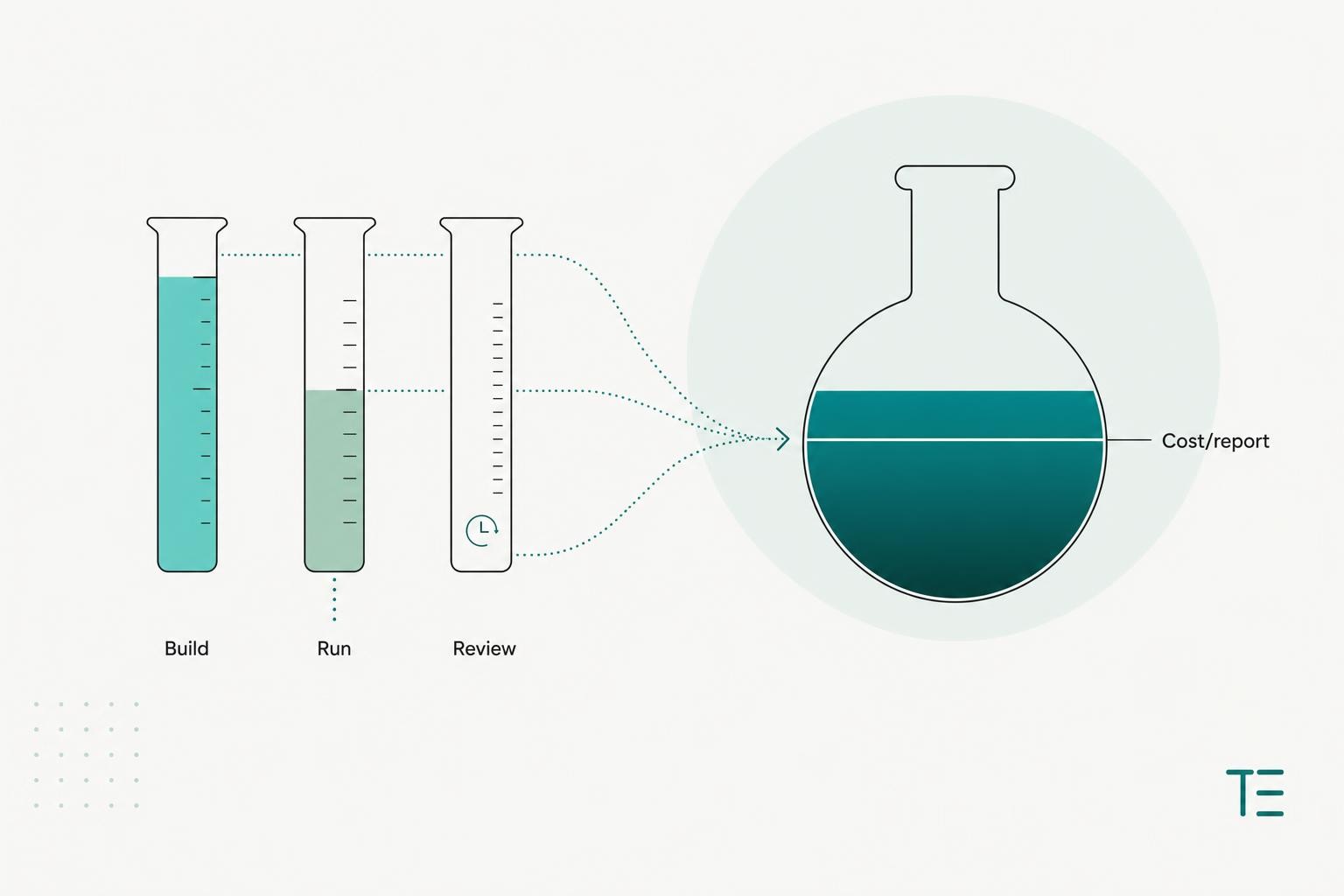
Three meters, and they behave differently. Build is one-time. Run compounds monthly. Review is the one nobody puts in the quote, and in month one it is usually the biggest line.
Meter one: build
Discovery, workflow design, integrations, error handling, evals and handoff docs. Almost all of the setup fee sits here. A narrow workflow with one data source is two weeks. A build stretches to six weeks when there are four or more source systems, client-specific metric definitions, or more than one approval path.
I will use our own overrun as the example. We scoped that 25-account reporting build at $12,000 fixed and four weeks. It landed at 5.5 weeks and about 166 internal delivery hours against a plan of 120. Three larger accounts had custom definitions for qualified lead, blended CPA and assisted organic conversion, buried in old Looker Studio formulas.
We charged a $1,500 change order in month one for the genuinely new scope, a second approval path and one custom export format. We absorbed the other 34 hours, roughly $3,000 to $4,000 of delivery time. Now we ask for three real past reports, the raw source dashboards and a written list of client-specific metric definitions before we quote.
Meter two: run
Platform executions, model tokens, hosting, logging, and a small monthly change budget for when a client platform shifts its API. Here is what the reporting build actually billed.
| Line item | Month one | Month four |
|---|---|---|
| Build fee | $12,000 fixed | $0 |
| Change order | $1,500 | $0 |
| n8n platform plan | about $65 | about $65 |
| LLM token spend | $78 | $46 |
| Hosting and database | $52 | $52 |
| Monitoring and logging | $18 | $18 |
| Human review | 68 hours | 26 hours |
| Review cost at $55/hour | $3,740 | $1,430 |
Read the review line first. Month-one software was $213 and month-one review was $3,740, about 18 times the software bill. We kept review high on purpose so account managers could grade AI drafts against their old manual reports. That agency went from about 50 hours a week on reporting to 5 to 7 hours, and the full multi-client reporting agent build is written up separately.
Four red flags in any quote you receive: no error budget, no ownership clause, no named monthly run estimate, and token cost described as negligible.
What do the workflows agencies automate first actually cost?
Here are the five we build most for agencies, at a 20-client shop. Volumes assumed: 20 reports, 150 qualified leads out of about 600 submissions, 400 ad variants, 70 SEO briefs and 8 onboardings per month.
| Workflow | Build | Monthly run | Review hours | Recurring cost per unit | First year with build amortized |
|---|---|---|---|---|---|
| Multi-client reporting | $8,000 to $14,000 | $120 to $300 | 20 to 35 | $60 to $110 per report | $95 to $170 |
| Lead qualification and routing | $2,500 to $6,000 | $40 to $150 | 4 to 10 | $2 to $5 per qualified lead | $3 to $8 |
| Ad copy variant generation | $3,500 to $7,500 | $75 to $250 | 8 to 20 | $1.30 to $3.40 per variant | $2 to $5 |
| SEO brief production | $5,000 to $10,000 | $150 to $500 | 18 to 40 | $16 to $39 per brief | $22 to $50 |
| Onboarding intake and handoff | $4,000 to $9,000 | $50 to $180 | 5 to 12 | $40 to $105 per intake | $80 to $200 |
The formula behind the last two columns is one line:
cost per deliverable = (monthly run cost + review hours x loaded hourly rate + amortized build) / monthly deliverables
Run it on the reporting case. Month four was about $181 in software and tokens, plus 26 review hours at $55, so $1,611 for 25 reports. That is about $64 per report. Amortize the $12,000 build over 12 months and you add $40, so the first-year all-in number is about $104 per report. That figure survives a partner meeting, because your team already knows what you bill for a monthly report.
Reporting costs the most to build because every client has slightly different metrics, even when the agency swears the template is standard. Client reporting automation is still the highest-volume target for most agencies. Lead qualification and routing is the cheapest place to start.
The cheapest complete workflow we have put into production was $2,500 to build and about $41 a month to run. A 6-person paid media shop doing roughly $900K a year was getting 80 to 120 inbound form fills a month. The founder read every single one. We built a Webflow to n8n to HubSpot qualifier with a Slack queue and a drafted reply for approval. MVP took 6 business days and production took 11, because field mapping and duplicate handling needed more testing than expected. Review is 2 to 3 hours a month, and qualified leads now get a reply in under 15 minutes when someone is online.
Zapier vs n8n vs a custom build: which is cheaper for my workflow shape?
The answer depends almost entirely on how many steps your workflow has, because the two platforms meter differently. n8n counts one execution per full workflow run, no matter how many steps are inside it. Zapier meters per successfully completed action step, with triggers and filters free. So a 10-node workflow run 1,000 times is 1,000 n8n executions but around 9,000 Zapier tasks.
That gap is not theoretical. A 16-person performance agency doing about $2.2M a year had 3,600 to 4,200 form fills a month across client landing pages. Their Zap checked duplicates, enriched the domain, scored the lead, updated HubSpot, posted to Slack, created a task and sent one of three email drafts. That averaged 8 to 11 billable action steps per lead, so 4,000 leads became roughly 34,000 to 38,000 tasks.
| Line item | Last Zapier month | First stable n8n month |
|---|---|---|
| Workflow platform | about $900 on the tier sized for 50,000 tasks | $65 |
| LLM tokens | $44 | $39 |
| Hosting and API service | $0 | $28 |
| Logging and alerts | included | $12 |
| Total run cost | $944 | $144 |
The move cost $4,500 and took 13 business days. We kept HubSpot and Slack, and replaced the multi-step Zap with one n8n workflow and a small scoring endpoint. The honest trade-off is that their ops manager could edit the Zap herself. After the move, small changes needed someone more technical. We documented the routing rules and kept a 2-hour monthly change budget, which is part of the run cost.
Self-hosting is where the free myth lives. I tell agencies to self-host when execution volume is high, data control matters, or custom code needs to sit next to the automation layer. One agency running 90,000 monthly executions across 38 client accounts moved to a managed VPS. The real self-hosted n8n cost was $367 a month: $34 compute, $15 backups, $18 monitoring and $300 for a maintenance-only block of hours, which is separate from a build retainer.
A custom build only beats both platforms when you have real volume, a client-facing interface, data you must own, or logic the platform would charge you per step to express. Those thresholds are covered in our post on whether to build or buy your AI marketing agent.
How much do the tokens cost on top of the platform fee?
Less than agency owners fear, and in a shape most people guess wrong. Long prompts are not the killer. Long outputs are. On OpenAI's published API pricing as of writing, GPT-5 bills $1.25 per million input tokens, $10 per million output tokens and $0.125 per million cached input tokens. API billing also runs on prepaid credits with no subscription ceiling.
My routing rule is cheap model for structure, expensive model for judgment. Anything that extracts, labels, dedupes, routes or checks a threshold runs on the cheap tier. Anything a client might read, challenge or use for strategy gets the stronger model. At a 30-person SEO shop producing about 180 briefs a month, moving extraction and clustering to a cheaper model took the monthly token bill from $312 to $146 with no drop in strategist quality scores. That retune took 4 business days and cost $1,800.
Because there is no plan ceiling, a runaway loop is a budget event rather than an error message. On day one of a build we set a separate API key per workflow, prepaid credits with a small balance, and usage alerts at 50, 75 and 90 percent. We also add five controls in code.
- A hard monthly budget checked before every model call
- Max retries of 2 or 3
- An hourly execution cap per workflow
- Output length limits on every prompt
- A kill switch anyone on the team can flip
One agency lead-routing workflow broke in testing when a CRM webhook kept resending the same contact. The hourly cap stopped it after 40 runs, wasted token spend was under $2, and the fix took 90 minutes.
What is the chance I spend the money and get nothing?
Higher than any vendor will tell you. In McKinsey's 2025 survey, 80 percent of respondents say efficiency is an objective of their AI work, but only 39 percent report EBIT impact at the enterprise level.
Our own number: roughly 60 percent of the agency automations we shipped in the last 18 months were still running on their intended cadence six months later. The survivors shared four traits. One named person owned the workflow after launch. There was a measurable target, like reporting hours under 10 a week. Review time was budgeted as part of unit cost instead of assumed away. And the workflow lived inside the existing stack, not a new portal.
The dead one I think about was a proposal generator for a smaller agency. It worked technically. Their packages changed every few weeks, nobody maintained the pricing rules, and it was abandoned after a month of heavy use.
When not to automate yet
I tell agencies to wait when the workflow saves less than 15 to 20 hours a month, changes more than once a month, or carries more than about 25 percent exception handling. A $6,000 workflow that saves 6 hours a month is $330 of labor at $55 an hour. Payback is too slow unless it creates revenue.
One 14-person agency wanted custom onboarding automation. Five new clients a month at 90 minutes each is 7.5 hours, and every strategist used a different intake form. I told them not to build. They standardized in Typeform first, then came back three months later at 11 onboardings a month. Then a $4,500 build made sense.
Should I bill clients for the tokens, absorb them, or mark them up?
Do not put tokens on an invoice as a line item. Clients buy reports, briefs and faster follow-up. Price the output and bury the token cost in your delivery math.
| Model | When I recommend it |
|---|---|
| Absorb into the retainer | Low token spend, healthy retainer margin, no client-facing AI product |
| Pass through at cost plus a platform fee | Enterprise client, transparent ops agreement, volatile usage |
| Productize per deliverable | Repeatable workflow, client-visible output, predictable unit cost |
My resell test: all-in cost per deliverable should be under roughly one third of what you charge for that deliverable. A 22-person content and paid media agency doing about $2.8M had us build an SEO brief workflow for $7,500. They produce 60 to 70 briefs a month. Month-one run cost was $238, split across $65 platform, $96 tokens, $47 scraping and SERP calls and $30 logging. Review was 31 strategist hours, dropping to 19 by month three once we tightened the outline rules.
That puts their all-in cost at $20 to $30 per brief before the build is amortized. Spread the $7,500 over 12 months and add about $10 a brief in year one. They sell it as an AI-assisted content strategy brief at $175, and bundle 8 briefs a month into a $2,000 add-on for larger clients.
That only works if they own the asset. Our default is that the client owns the repo, workflow exports, prompts, schemas and docs, and holds the API keys from day one. If you plan to resell, make sure that is written down, or that you have a clear white-label AI development license.
Where to start this week
Pick the workflow with the highest monthly volume times minutes per unit. For most 10 to 50 person agencies that is client reporting or inbound lead follow-up.
Then run the formula with four of your own inputs: monthly volume, review minutes per unit, loaded hourly rate and platform executions per run. If the result is under about $800 a month of labor, do it yourself on a $24 to $60 plan and prove the process first. Over that, scope a fixed-scope AI sprint with one agreed KPI.
If you have $10,000 and one quarter, spend it on one workflow in this order. Week 1 is the workflow audit and KPI definition, $0 to $1,000. Weeks 2 to 3 are a fixed-scope MVP for one client or one pipeline, $2,500 to $4,000. Weeks 4 to 8 are the production build, $5,000 to $7,000. Weeks 9 to 12 are the tuning pass everyone forgets, $1,000 to $2,000. Add $100 to $300 a month in platform, tokens and hosting starting at MVP.
Judge it after the second full cycle, not the first. My payback target is under 90 days for labor-saving workflows, and faster for anything tied to speed-to-lead.
If you want a second opinion on which workflow to price first, book a discovery call. Free 30 minutes, no pitch deck.
Frequently asked questions
Who owns the automations if I stop working with the agency that built them?
Whatever your contract says, so read it before you sign. Our default is that you own the repo, workflow exports, prompts, schemas and documentation, and that vendor accounts and API keys are yours from day one. When an engagement ends we confirm your admin access and rotate any temporary credentials we held.
Can I just build this myself in n8n or Zapier without hiring anyone?
For a narrow workflow, yes, and I will tell you to. A form-to-CRM qualifier with a Slack queue is a weekend of work for a technical ops person on a starter plan. It stops being a DIY job when you need enrichment from paid APIs, CRM deduplication across pipelines, assignment rules and reporting in the same system.
How long does a first AI automation build take from kickoff to production?
One to two weeks for a single-workflow MVP, four to eight weeks to production. Our cheapest agency build hit MVP in 6 business days and production in 11. Reporting builds run longer, and the thing that stretches them is almost always client-specific metric definitions rather than the AI itself.
Should I pay a fixed project fee or a monthly retainer?
Fixed fee for the build, small retainer for the run. Fixed price forces both sides to define scope, which is exactly where reporting projects go wrong. The retainer should cover monitoring, API breakages at client platforms and a couple of hours of changes a month, not open-ended new features.
How do I know the AI output is as good as what my team produced?
Define one quality check before the build starts, then compare side by side for the first full cycle. On the reporting build we kept 68 review hours in month one so account managers could grade AI drafts against the manual versions. If review time is not falling by month three, the workflow is not finished.