
Last year Tech Emulsion built two AI agent systems for marketing agencies. One cut operational work in paid media by 80%. The other took weekly client reporting from around 50 hours a week to about 7. Neither agency fired anyone, and both changed how they hire. That gap between "we automated most of the work" and "we cut the team" is the honest answer to whether AI agents can replace your marketing team. This post covers what we saw, what broke, and how we build these systems now.
Can AI agents replace your marketing team?
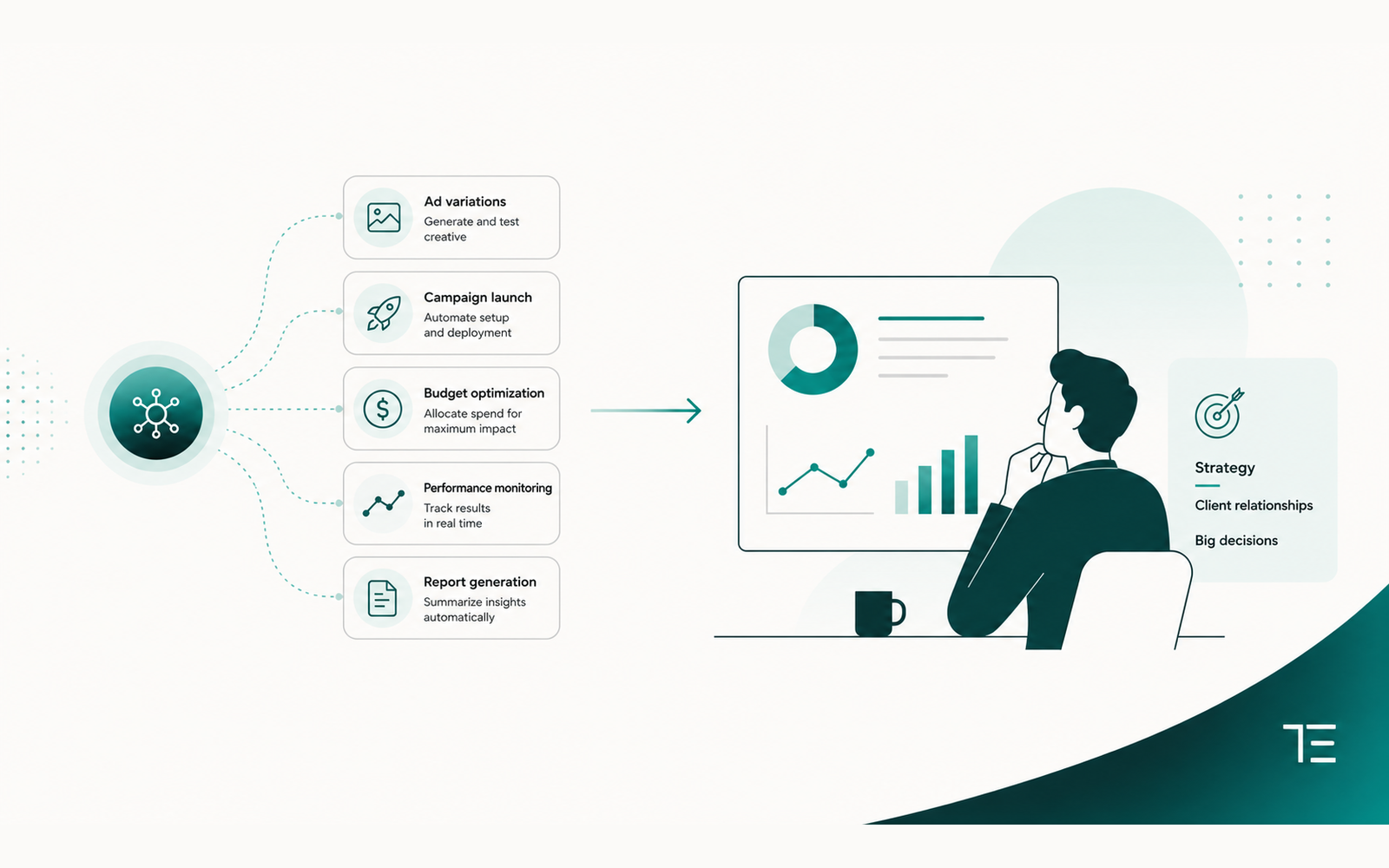
AI agents can take over 60 to 80% of execution work in a marketing team today: ad variations, campaign launches, budget moves, data pulls, and report drafting. They cannot yet own strategy, client context, exception handling, or accountability. In practice they change your headcount economics first. You stop hiring the next person, and each existing person supports far more clients.
That is the short version. The rest is the evidence from work Tech Emulsion has shipped for agencies, plus the numbers I use on sales calls.
Who is asking this question
The person searching this is usually an agency founder with some AI FOMO. Payroll is the biggest line item, margins are tight, and every LinkedIn post claims someone replaced a five-person team with a workflow. The question underneath is whether you can cut payroll and keep margin, and how much of this is real.
I am Hassan, and I run Tech Emulsion, a 30-person agency, so I understand the pressure. The answer depends on which work you mean, and the two projects below show the difference.
What AI agents took over at two marketing agencies
Ad operations: 80% less operational work and 10% more ROAS
The first system was for a paid media agency out of Charlotte. Tech Emulsion built it on the Claude API with agents wired into the ad platforms. The agents create ad variations, launch campaigns, check performance, move budgets, test creatives, and optimize against targets a human sets.
Operational work time dropped by about 80%. ROAS (return on ad spend) across the managed accounts went up around 10%, mostly because budget moves and creative tests happen continuously instead of when a media buyer gets to them.
The human side of the work shifted. People still decide strategy, set goals such as CAC (customer acquisition cost), ROAS, budget caps, and target markets, choose the brand message and creative direction, approve major changes, and handle unusual situations. A media buyer who used to spend the whole day inside Meta Ads Manager now spends it saying "we want customers under $40 CAC, focus on these three products, push this new positioning," and the agents run the execution.
Weekly client reporting: 50 hours a week down to about 7
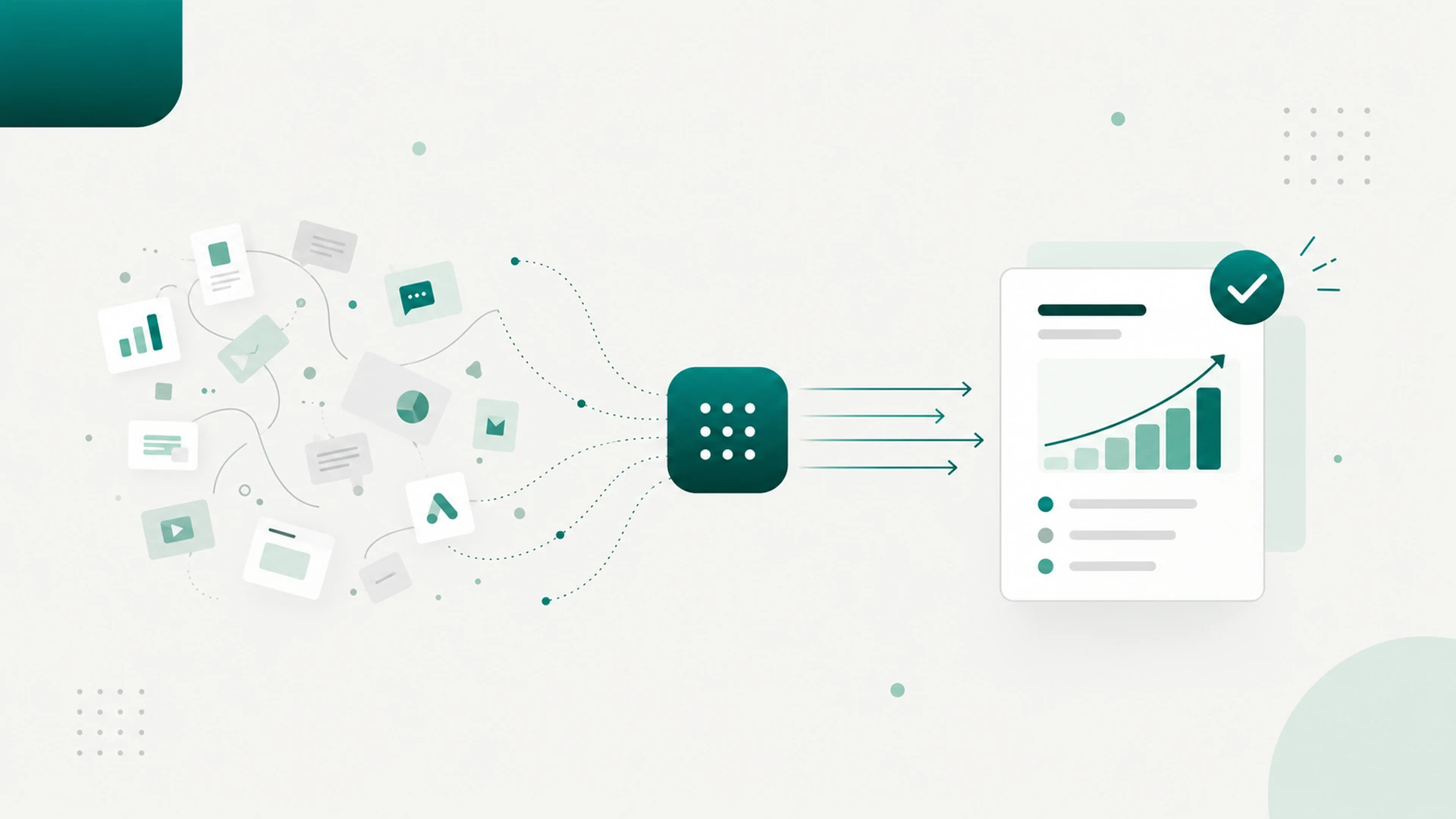
The second system was a weekly reporting agent for an agency with about 25 clients receiving weekly performance updates. An account manager spent roughly two hours per client every week on the same sequence.
Log into Meta, TikTok, Shopify, and the CRM. Pull the numbers. Compare periods. Find what changed. Work out why. Write commentary. Format it into that client's template. Repeat.
That came to around 50 hours a week across the client base. The pain was the repetition. Every client had a slightly different data setup and reporting requirement, so last-minute scrambles were constant and output was inconsistent.
After the agent went live, human time dropped to about 5 to 7 hours a week. Account managers now spend around five minutes reviewing each report instead of two hours building it. This is the kind of build we do under our custom reporting for agency clients work, and the agency's goal from day one was to free the account managers to prepare for and work with clients.
We built a similar restaurant-performance reporting agent for another agency that replaced manual work equivalent to about 20 full-time employees. Same pattern. The account managers stayed, and their time moved to the restaurant partners.
What the remaining human hours actually cover
The 5 to 7 hours that remain in the reporting workflow are hours you would never want to automate anyway.
- Reviewing drafts: checking numbers, insights, and wording before a client sees them.
- Adding context the data cannot know: "sales dropped because inventory ran out," which no ad platform will ever tell you.
- Handling edge cases: unusual campaign structures, missing data, new channels, attribution problems.
- Fixing failed runs: expired tokens, API changes, disconnected credentials.
- Client-specific edits: different KPIs, commentary, or formats.
- Strategic thinking: deciding what the client should do based on what the report says.
The job title stays the same. The job content moves from "build the report" to "QA, context, and judgment." That change is why the replacement framing misleads people.
Why headcount economics change before headcount does
Here is the contrarian view I hold. AI agents rarely replace whole teams overnight. They change the economics of headcount first, and the headcount changes follow over years, mostly through who you stop hiring.
The "AI replaces everyone" crowd misses that most real workflows still need judgment, context, exception handling, client communication, and someone accountable. A reporting agent can build 90% of a report, and someone still needs to know that sales fell because of a stockout. They also confuse task automation with job elimination. Automating 70% of someone's tasks does not let you remove 70% of the people, because work is messy and unevenly distributed.
The "AI is a toy" crowd misses that the impact is real and quiet. You never hire the next ten people. A 20-person agency doubles revenue and stays at 20 to 25 people.
Junior execution roles shrink. Freelancers and outsourced vendors get cut. People who leave go unreplaced. Senior staff manage far more clients.
Forrester's June 2026 report with the 4As found that nine in ten US marketing agencies use generative AI and half use agentic AI for marketing execution, with staff productivity as the main objective. The better question to ask is how much more revenue each employee can now support.
The five media buyers example
Say you have 5 media buyers managing 25 clients. After agent automation, those same 5 people can manage around 60 clients. You now have two choices.
- Cost-saving path: operate with 2 or 3 media buyers instead of 5, over time, through attrition.
- Growth path: keep all 5 and take on another 35 clients without adding payroll.
Most growing agencies pick the growth path first because it is far more profitable. The difference is whether you bank the margin as lower cost or as higher revenue on the same cost. This is the pivot I described in automation first consulting, seen from the client's side.
What the agents got wrong early on
The first versions of the reporting agent had four recurring problems.
- Different clients had different data setups. One used Shopify plus Meta, another had CRM data, and naming conventions varied across accounts.
- The model produced plausible but weak insights, like "ROAS declined because spend increased," with no business context behind it.
- Missing or broken data produced bad reports where it should have produced no report.
- Output drifted from the agency's own analysis standards and from each client's format.
The fix for all four was the same: scheduled runs, fallbacks, alerts, client-specific configuration, and mandatory human approval before anything ships. Fully autonomous sounded good in the pitch. Supervised autonomy is what survived contact with 25 real clients. I wrote about why systems fail quietly after launch in AI Ops and ownership, and this project is the reason that post exists.
How we build a marketing agent that holds up
The stack Tech Emulsion uses
- Meta, Google Ads, GA4, Shopify, and HubSpot APIs for raw marketing, sales, and CRM data.
- n8n to run workflows on schedule, call APIs, retry failures, send Slack alerts, and move data between systems.
- Python or TypeScript to calculate ROAS, CAC, week-over-week changes, attribution metrics, and anomalies.
- Postgres on Supabase for normalized metrics, client settings, previous reports, and workflow state.
- Claude API to read the calculated data, identify what changed, explain likely causes, and write commentary, calling tools like get_campaign_data() when needed.
- LangGraph, optionally, for flows that need to pause, hold state, retry, and wait for human approval.
- Notion, Google Docs, or Slack for review and approval.
- LangSmith and Sentry for logging what the agent did and catching failures.
- AWS, Railway, Render, or Vercel for the custom backend pieces.
One rule matters more than any tool choice. For a reporting agent, 70 to 80% of the workflow should be deterministic software: fetch, calculate, validate, save, schedule. The AI layer handles the remaining 20 to 30%: what matters, why it probably happened, how to explain it, and what to recommend. That split beats six autonomous agents talking to each other, and it is the core idea behind our approach to agentic AI engineering for any client.
What a weekly run looks like
Every Monday at 6am the sequence is strict, so here it is in order.
- n8n wakes up on schedule.
- It pulls data from Meta, Google Ads, GA4, Shopify, and the CRM.
- Python calculates the last 7 days against the previous 7: revenue, spend, CAC, ROAS, conversion rate, and the changes.
- Rules flag noteworthy events, such as CAC moving more than 15%, spend moving more than 20%, or a campaign that suddenly stopped converting.
- Claude receives the clean data plus the previous report, the client's targets, the account strategy, client-specific notes, and the reporting style, then writes the commentary.
- A second QA step, either rules or another model call, checks that every number matches the supplied data, that the important anomalies were mentioned, and that the format is right.
- The draft appears in Notion.
- The account manager reviews, edits, approves, and sends.
How long it takes to build
For a competent team, a production reporting agent takes 4 to 6 weeks. Week one is discovery: map what the account manager does today, collect 10 to 20 historical reports, define what they inspect when ROAS falls, and connect the platforms. Week two is the reporting engine, and by the end of it you should be able to generate a report with no AI in it at all.
Week three adds the intelligence layer, tested against the historical reports. Week four adds approval, retries, missing-data handling, alerts, logging, client configs, and hallucination checks. Weeks five and six run the system in parallel with humans, comparing AI reports against human reports every week before anything goes out on its own.
A single-client MVP with Meta and Shopify takes 1 to 2 weeks. An agency-wide platform with hundreds of clients, multi-tenancy, permissions, and dashboards takes 8 to 12 weeks or more. If you are weighing this against an off-the-shelf tool, we laid out the tradeoffs in build versus buy for agency reporting.
What agency founders ask before they buy
Three objections come up on nearly every sales call.
"What if the AI gets the numbers wrong?" A founder is picturing a report that says ROAS was 4.2 when it was 3.1. My answer is architectural. Deterministic code calculates every financial metric from Meta, Google, Shopify, and GA4 data. Claude only interprets numbers that have already been verified, and a human approves before the client sees anything.
"What happens when the agent breaks?" APIs expire, Meta changes things, credentials disconnect. We design assuming things will break. If data is missing or looks abnormal, the agent stops, retries, logs the error, and alerts the team in Slack. Failing safely beats pretending it never fails.
"Will this actually save me money?" I answer with their numbers. Five account managers spending 8 hours a week on reporting is 40 hours. After automation, call it 5. That is 35 hours a week, or 1,820 hours a year, and at a $30 fully loaded hourly cost it is $54,600 a year of capacity recovered.
Then the more useful question: could those account managers handle another 10 clients with those hours? At that point I am selling capacity and margin, which is what AI automation for marketing agencies comes down to.
When this does not fit
If your reporting or ad ops process changes every week and nobody can describe it consistently, an agent will automate the chaos. Fix the process first.
If you have fewer than 8 or 10 clients, payback on a custom build is slow, and a lighter workflow automation setup may be enough. If nobody on your team will own the system after launch and fix it when a platform API changes, it will decay within months. I covered the difference between an AI app and an AI system in AI systems engineering.
Common questions about AI agents replacing marketing teams
Can AI agents fully replace a marketing team?
Today, no. They can take over most execution work in paid media, reporting, and content operations, typically 60 to 80% of the hours. Strategy, client relationships, context, and accountability still sit with people, and every system we run keeps human approval in the loop.
Which marketing jobs are most affected by AI agents?
Junior execution roles feel it first: media buying assistants, reporting analysts, and anyone whose day is mostly pulling data and moving budgets. Senior roles change shape. They manage more clients and spend more time on strategy and judgment.
How much money can an agency save with AI agents?
It depends on hours and loaded cost. A team spending 40 hours a week on reporting at $30 an hour recovers roughly $54,600 a year when that drops to 5 hours. Most agencies gain more by using those hours to serve additional clients.
How long does it take to build a marketing AI agent?
A one-client MVP takes 1 to 2 weeks. A production reporting or ad ops agent covering 20 to 30 clients with approvals, retries, and monitoring takes 4 to 6 weeks. Agency-wide platforms run 8 to 12 weeks or longer.
Is it safe to let AI write client-facing reports?
It is safe when the AI never calculates the numbers, every claim is checked against source data, and a person approves before sending. Our clients run it this way, and the review step takes about five minutes per report.
Where to start
Start with one workflow, usually weekly reporting or ad ops, scoped to a handful of clients. Tech Emulsion is an official Anthropic Claude partner and builds these systems for marketing agencies as our primary focus. Bring your current process and your client count. In a 30-minute call we will tell you whether a build makes sense and what it would cost, and you can book a discovery call whenever you are ready.