
Tech Emulsion has had an engineer embedded with LVRG Ventures since May 2026. The engineer sits in their Slack, talks directly with their team members and department heads, and builds inside the software they already run on. That setup has a name: forward deployed engineer, or FDE.
I'm Hassan, CEO of Tech Emulsion. Agency owners keep asking me about this role because Palantir, OpenAI, and Anthropic are all hiring for it. Here is what an FDE is, what one does inside a marketing agency, what it costs, and when I would tell you to skip it.
What is a forward deployed engineer?
A forward deployed engineer (FDE) is a software engineer who works inside a customer's team, in their channels and their tools. The FDE watches how the work gets done, then builds, deploys, and maintains software around those workflows. The role carries ownership of the business outcome along with the code, from first conversation to production.
Palantir made the role famous. Its description centers on direct access to the people using the software and ownership all the way to deployment. OpenAI's version of the role stresses production delivery, adoption, scope tradeoffs, and reusable patterns.
For a marketing agency, the idea translates simply. An embedded engineer joins your Slack, gets individual logins to your tools, and talks to your account managers and ops lead with no middle layer. The output is AI automation and internal tooling shaped around how your agency operates, which is the core of the AI systems we build for marketing agencies.
A freelancer or a project shop takes a brief and returns a deliverable. That works well when the deliverable is already clear. An FDE earns the fee when the right thing to build is still unknown and the answer lives in your team's daily work.
What does an FDE do inside a marketing agency?
Tech Emulsion's work with LVRG Ventures covers email marketing, GoHighLevel automation, internal tools, and prospecting for several offers, including There San Diego. One embedded engineer supports several connected functions. That breadth is typical of the role.
The prospecting app Tech Emulsion built for LVRG Ventures
Before the build, the LVRG team handled research, prospecting, and qualification by hand. Someone had to find businesses, gather details, judge whether each one fit an offer, and identify a person worth contacting.
Our engineer built one application that joins those steps:
- Apify scrapers collect business information from Google, including names, locations, contact details, and services.
- Hunter.io and Explorium APIs enrich each record with company information and decision-maker data.
- A GoHighLevel integration connects the app to the systems the team already operates in.
- An Instantly integration supports the outbound campaigns.
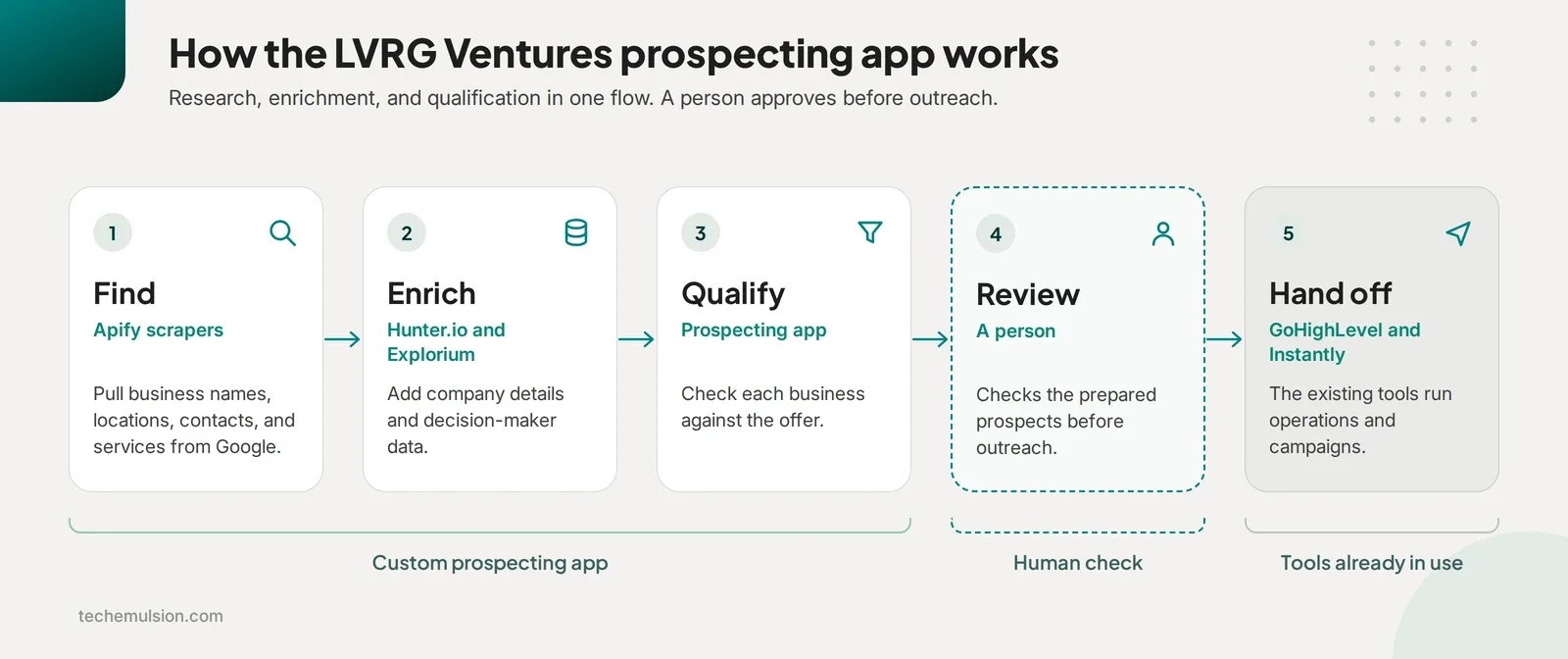
A person still reviews the prepared prospects before any outreach goes out. The human role moved from doing the research to checking it. I have no measured performance figures to publish for this build yet, so I am describing what we built and leaving results out. The same pattern sits behind our outbound automation for agencies.
The scope correction a spec would have missed
Our engineer's first instinct was to pull more of Instantly's campaign features into the app, so the client could manage campaigns with more flexibility. The same thinking extended to GoHighLevel (GHL).
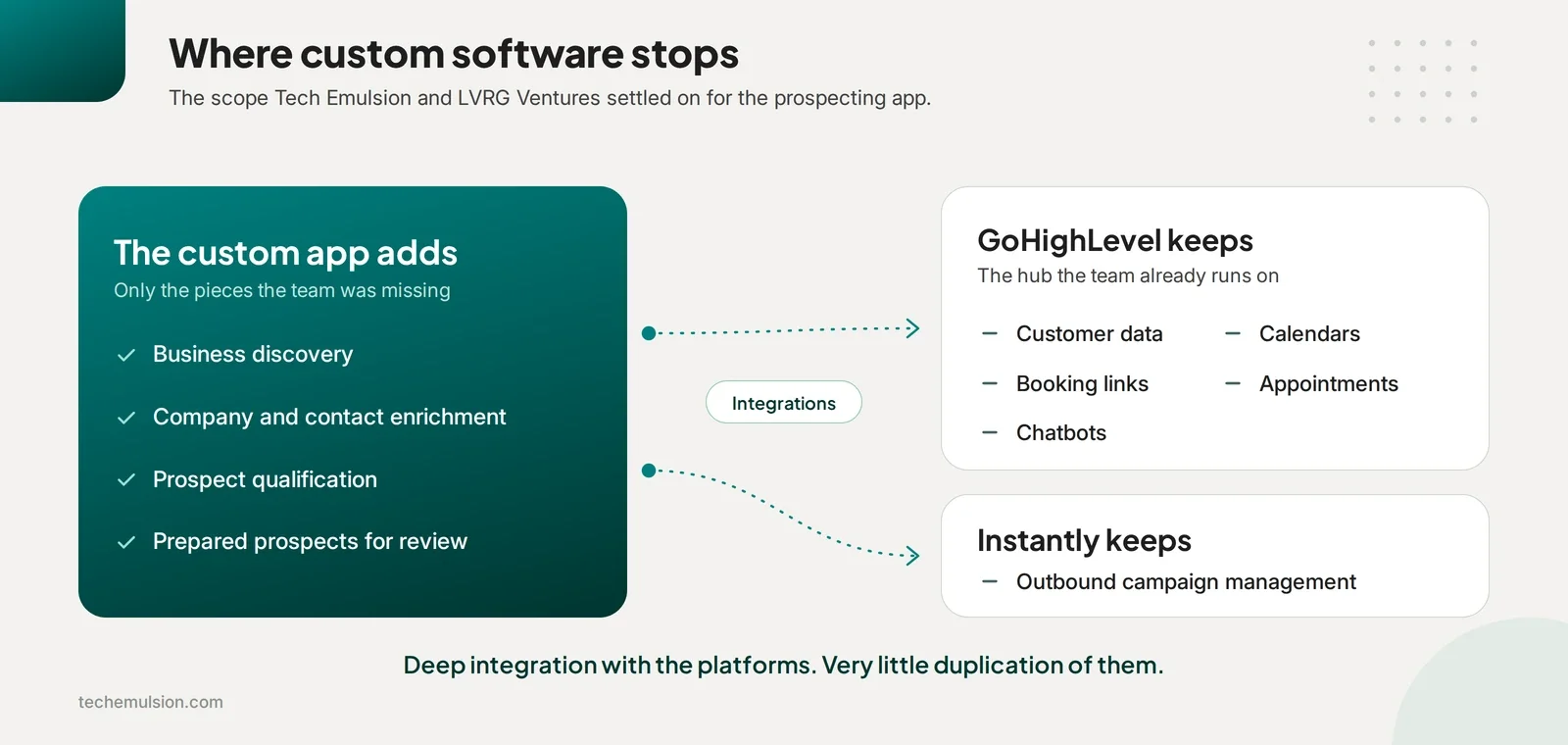
A member of the client's team challenged that direction. They wanted us to build the pieces they were missing and let the existing platforms keep doing what they already did well.
The reason became clear once the engineer saw the full picture. GHL held their customer data, calendars, booking links, appointment management, and custom chatbots. LVRG also runs a community where they teach GHL and digital marketing. The platform was part of how they operate and part of what they teach.
So the app became an extension of that environment. It integrates deeply with GHL and duplicates very little of it. That correction came out of an ordinary working conversation with the people who use the systems. Direct access to the team is what set the application's boundaries.
What should the first two weeks look like?
Here is how I structure the first two weeks when an agency brings in a Tech Emulsion engineer. I'll use automated client reporting as the example workflow.
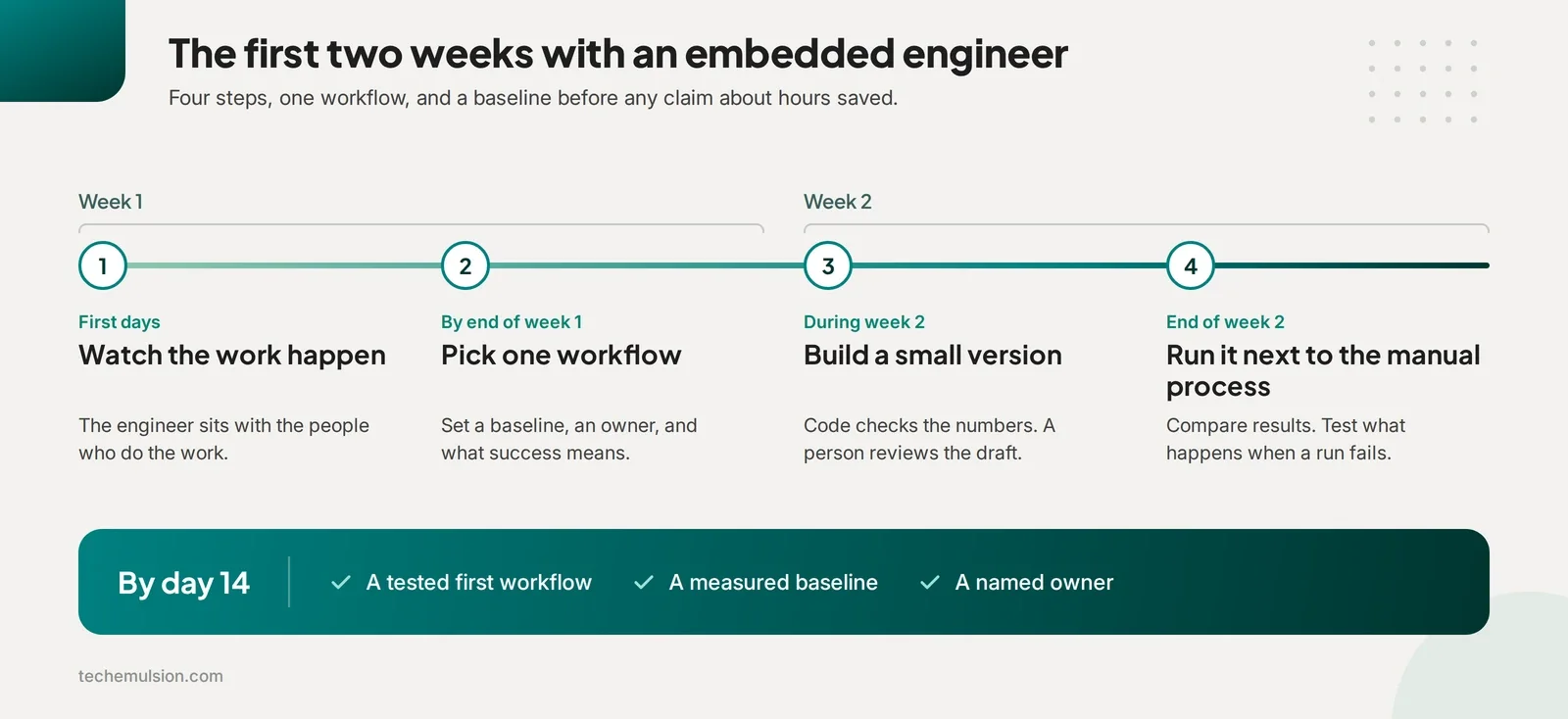
Watch the work happen
In the first few days, the engineer sits with the people doing the work. An account manager shows them how a real client report gets prepared. The ops lead shows how work moves between departments.
The most useful request is: "Show me the last time you did this, including where you got stuck." That surfaces details a requirements document misses, like someone fixing campaign names by hand or checking figures against a second system.
Pick one workflow and set a baseline
By the end of week one, I want one clearly scoped workflow, one person responsible for it, and an agreed definition of success. For reporting, we measure preparation time, review time, and corrections.
We also settle what each metric means. An ad-platform conversion and a qualified opportunity in the CRM should never quietly become the same "lead" in a report. The engineer tests data access this week too, because an integration blocker found early can change which workflow goes first.
Build a small working version
In week two, the engineer builds inside the existing process where practical. Code collects the data, validates it, and calculates the metrics. The model drafts commentary from those validated figures and approved account context, and the account manager reviews the draft. It is the same split I describe in how to set up an AI marketing agent from scratch.
Missing data triggers a visible exception. A failed connection should never turn into a confident statement that a campaign generated zero leads.
Run it next to the manual process
The engineer compares the output against the manual version, records every correction, and tests failure handling. If a run fails halfway, restarting it should never create duplicate reports or notifications.
By day 14, the goal is a tested first workflow, a baseline to measure against, and clear ownership of the AI system in production. Any claim about hours saved comes from the runs after that.
Does your marketing agency need a forward deployed engineer?
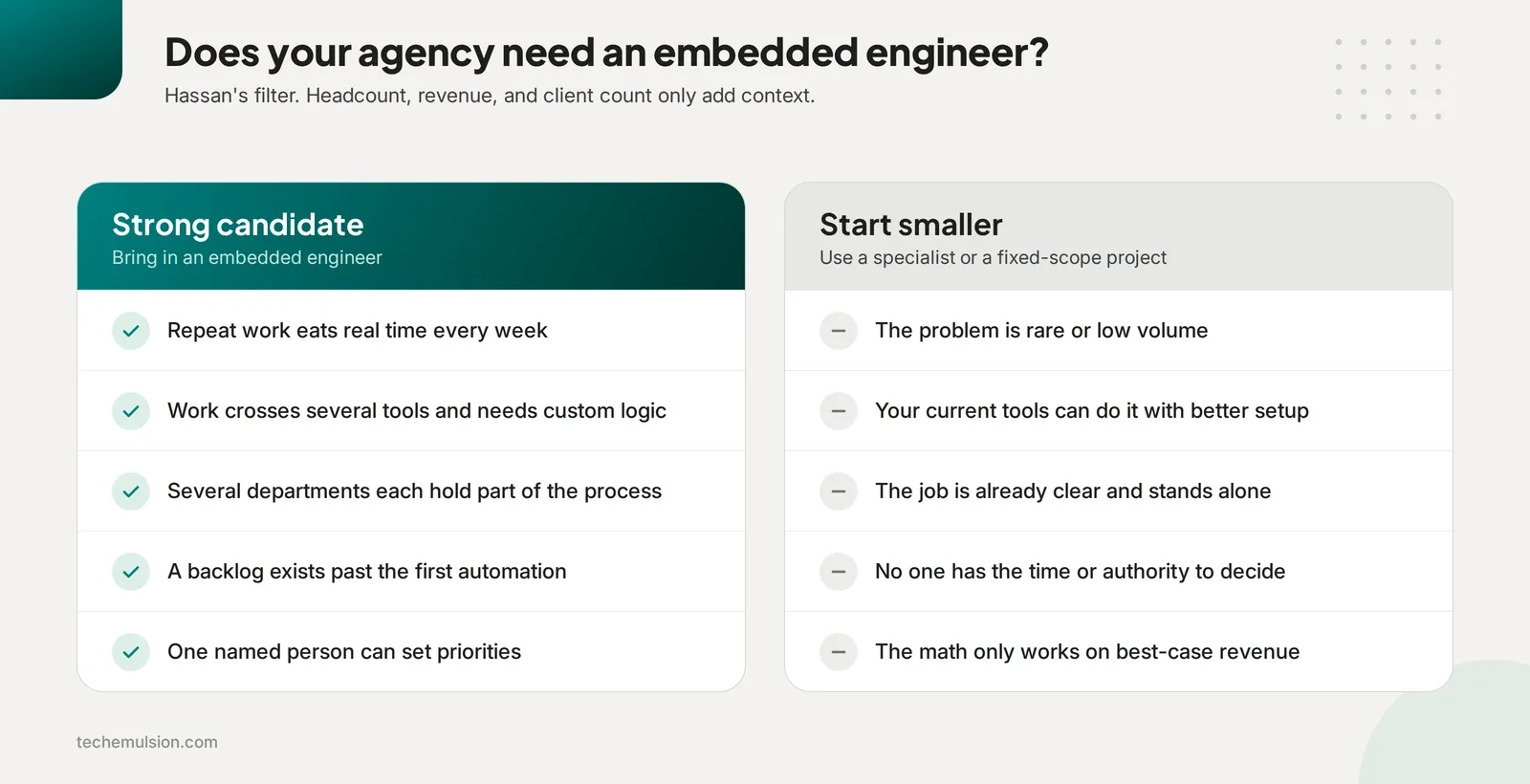
Bring in an embedded engineer when you have valuable, recurring work that requires someone to understand your agency from the inside. Headcount, revenue, and client count give me context. None of them qualifies or disqualifies an agency alone.
These signals make an agency a strong candidate:
- Research, qualification, reporting, or handoffs eat meaningful time every week.
- Important work crosses several systems and needs custom logic, data handling, or an internal interface.
- Different departments hold different pieces of the process, and their feedback will shape the build.
- A prioritized backlog exists beyond the first automation, plus systems that need maintenance.
- A named person can set priorities, explain exceptions, arrange access, and review the work.
These signals tell me to start smaller or hold off:
- The problem is occasional or low volume.
- Existing platform features cover the need with proper configuration.
- The deliverable is already clear and can ship as a standalone project.
- Nobody inside the agency has the time or authority to make decisions.
- The numbers only work if optimistic revenue projections come true immediately.
On team size, I look at coordination. If account managers, salespeople, and delivery staff keep chasing each other, reconciling records, and copying information between tools, that deserves engineering attention.
On client count, I count repeated work. Twenty clients that each need an hour of the same weekly preparation is 20 hours a week worth investigating. Expect to recover less than the full 20, because review, exceptions, and maintenance still take time.
On revenue, I look at service revenue, margins, and available cash. Client ad spend passing across your books says nothing about whether you can afford an engineer.
Run the numbers conservatively
Add up the engineer, extra software and API costs, and your own supervision time. As a worked example, if those total $3,000 a month and a recovered hour is truly worth $30 to your business, break-even is 100 recovered hours a month. Those figures are inputs for the math, and yours will differ.
Recovered capacity also needs a destination. It can absorb existing demand, cut overtime, or defer a planned hire. This matches what I have seen about AI changing headcount economics before it changes headcount.
If your problem is already contained, buy something smaller. An agency that needs its GHL pipelines and calendars configured properly should start with a GHL specialist. One clearly defined integration fits a fixed-scope project better than full-time embedding.
The best FDE prevents software you would have to own
My contrarian view: reward your embedded engineer for the unnecessary software they stop you from owning. I judge the hire on two measures. How much operational work disappeared, and how much maintenance responsibility got added.
Hiring an FDE creates a pull toward visible development. More features, more dashboards, more functionality inside your own app. Every rebuilt feature that already works elsewhere becomes a lasting obligation. Someone has to maintain it, handle API changes, investigate discrepancies, and decide which system owns each piece of data.
LVRG Ventures is my evidence. The valuable custom work was the prospecting application. The valuable restraint was leaving campaign management in Instantly and operations in GHL.
Proprietary software is still the right call when the workflow itself is your competitive advantage. Make that decision on purpose, with the continuing cost in view. Ask any engineer you are considering these questions:
- Which capabilities should stay in our existing platforms?
- What custom work creates an advantage we cannot get with configuration or integration?
- What will our team be able to operate without asking you for help?
I also put "what we chose not to build, and why" in the engineering review, next to what shipped.
The mistake that stalls embedded engagements
The failure I watch for is giving everyone access to the engineer while nobody owns the priorities. Sales asks for a new export format. An account manager wants different qualification fields. Operations asks for a dashboard fix. Each request sounds small, and the engineer wants to help.
Then the main workflow slips. The owner sees a missed commitment, and the engineer believes they were serving the client. That gap turns into a trust problem fast.
The fix is one person who owns priorities and one visible work queue. Your team still talks to the engineer directly, and every new request comes with a decision about what it displaces. Agree separately on what counts as an urgent production issue, because a broken live workflow deserves a faster response than a dashboard tweak.
What does a forward deployed engineer cost at Tech Emulsion?
A dedicated embedded engineer from Tech Emulsion starts at $15 per hour. Full-time is 40 hours a week, which comes to $600 per week, or about $2,600 per month averaged across a year. Part-time arrangements are available.
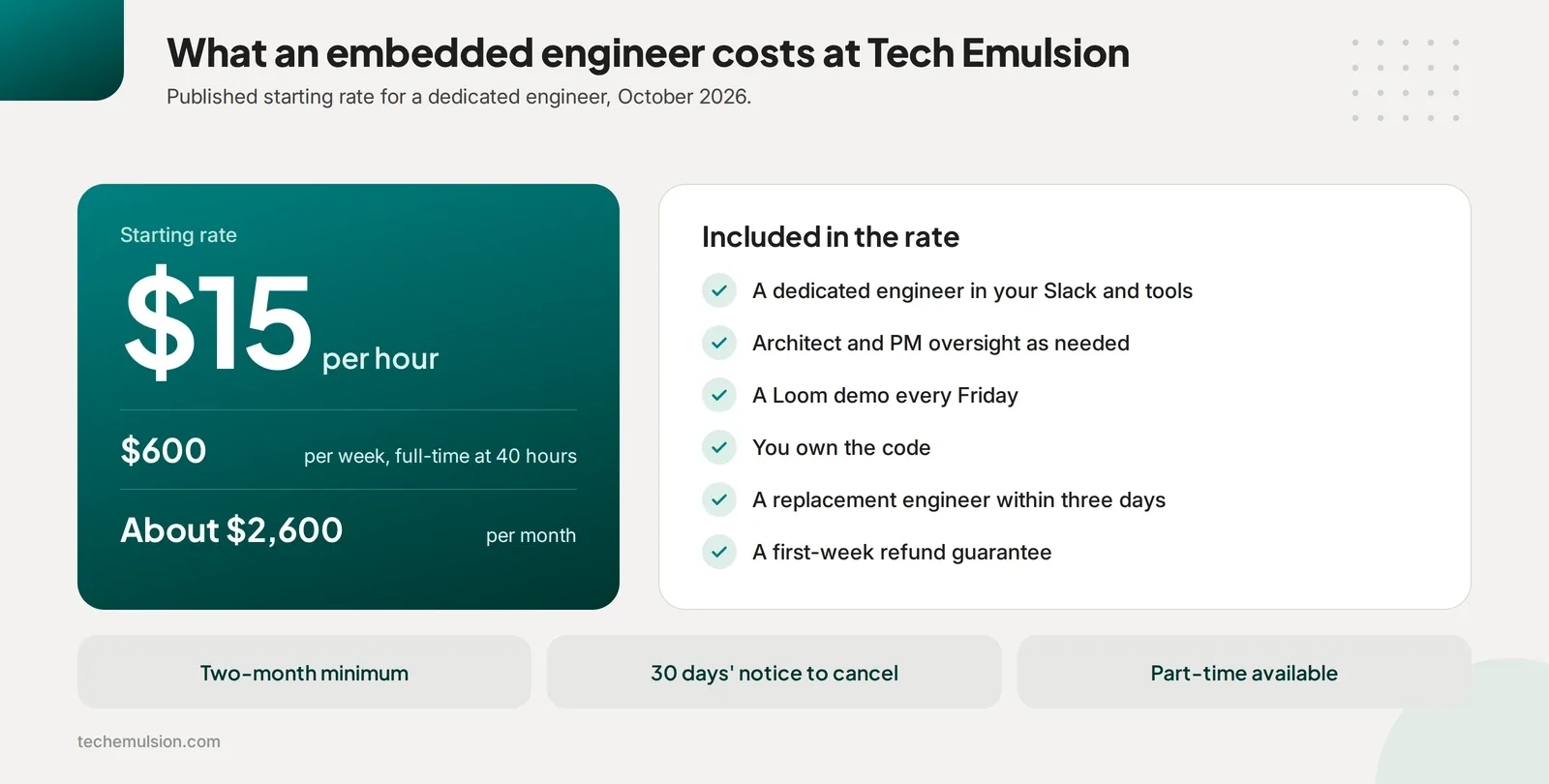
The rate includes:
- A dedicated engineer working directly with your team and your existing tools
- Architect and PM oversight as needed, covering technical decisions and delivery
- A dedicated Slack channel
- A Loom demo every Friday showing progress you can review
- Full ownership of the code built for you
- A replacement engineer within three days if the placement is a poor fit
- A first-week refund guarantee
The minimum commitment is two months, and cancellation takes 30 days' notice. Tech Emulsion is a US LLC with around 30 people, an engineering team in Pakistan, and official Anthropic Claude Partner status.
Questions agency owners ask about forward deployed engineers
What is the difference between a forward deployed engineer and a freelancer?
A freelancer delivers against a brief you write. A forward deployed engineer joins your team's channels, learns the workflow firsthand, and helps decide what should be built before building it. The FDE also stays to deploy, maintain, and improve the system.
Will an engineer in Pakistan overlap with my US working hours?
Tech Emulsion engineers can attend early-morning meetings in your US timezone. More overlap with your working day is available at an adjusted rate. We agree on exact overlap hours, meeting times, response expectations, and urgent incident coverage before the engagement starts.
How much access to client data does an embedded engineer need?
Only the access the scoped work requires. For GHL, that means an individual user account, the relevant subaccounts, and restricted API permissions, with credentials kept in an agreed password manager. Tech Emulsion signs an NDA first, and your agency keeps control of every account and deployed system.
Should I hire an in-house engineer instead?
If you can afford the right person and have enough ongoing work, an internal hire is a good decision. An embedded engineer lets you learn how much engineering capacity you need before you commit to permanent headcount. We agree on code access, documentation, and handover upfront so a future hire can build on the work.
How much does a forward deployed engineer cost?
At Tech Emulsion, a dedicated embedded engineer starts at $15 per hour with architect and PM oversight included. Full-time is about $2,600 per month. The minimum term is two months.
How long before an FDE delivers something useful?
The goal is a tested first workflow within two weeks, with a measured baseline and a named owner, provided access and scope allow it. Proof of sustained time savings comes from the weeks of live runs that follow.
Book an intro call for an embedded engineer
The best FDEs are problem solvers and perpetual learners. You get one engineer for your technology needs, and a steady answer to the fear that your agency is missing out on AI.
If the signals above describe your agency, look at how our forward deployed engineering engagement works. Then book an intro call and bring one workflow that eats your team's week. I'll tell you plainly whether an embedded engineer fits, or whether something smaller will do.