
Agency owners tend to ask me "will my marketing agency still be relevant in 5 years?" right after something specific happens. A client hires an in-house marketer, uses AI for drafts and reporting, and ends the retainer. Or another client asks why the invoice looks the same now that AI writes the first draft.
I'm Hassan, CEO of Tech Emulsion, and we build AI automation for marketing agencies. Here's my straight answer, the numbers behind it, and the thresholds I use before automating anything.
Will my marketing agency still be relevant in 5 years?
Yes, if it sells outcomes and runs its repeatable execution on automation. By 2031, clients will still pay agencies for strategy, niche expertise, creative judgment, and accountability for results. The agency that mainly sells human hours for reports, first drafts, resizing, and data entry gets squeezed, because AI keeps pushing the price of that labor down.
The line I use on calls is simple: AI kills the labor-arbitrage version of the marketing agency. Labor arbitrage means your margin comes from buying skilled hours at one price and reselling them at a higher one. When AI makes those hours cheaper for everyone, your clients included, that spread shrinks.
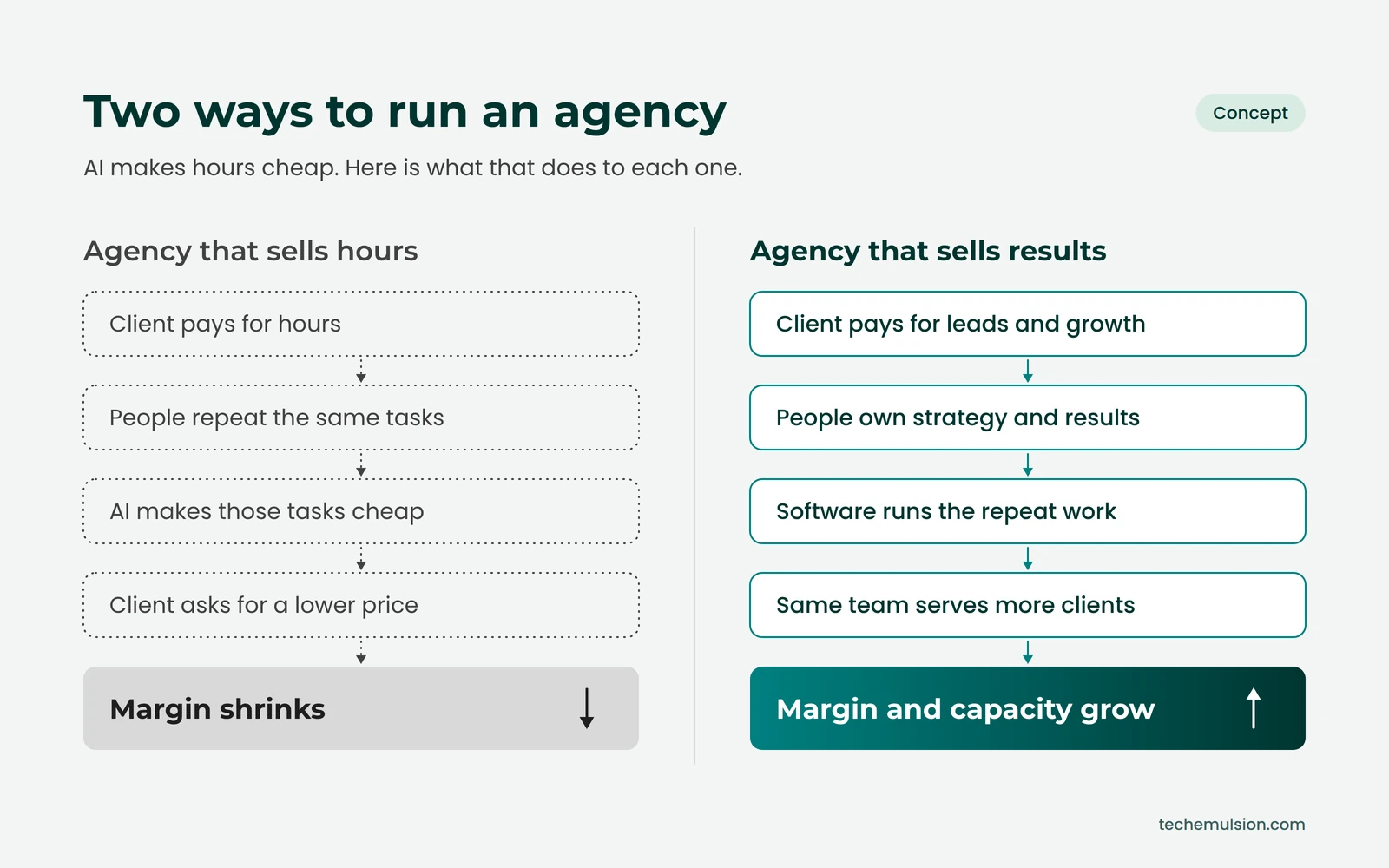
The uncomfortable part is that an agency can still have clients in 2031 and still be a bad business. If the price of execution drops while you keep today's headcount and workflows, revenue can hold while margins collapse. The opportunity is to automate the execution layer before the market forces you to cut prices.
That's the direction behind our work with marketing agencies. We find repetitive operational work, remove the human hours with software, and keep judgment and approvals with people.
Which agency services is AI squeezing first?
The squeeze starts wherever the value is volume and the steps repeat. If your agency mainly sells any of these, AI is already making that labor cheaper:
- Producing high-volume content, like 20 blog posts.
- Building client reports by hand.
- Resizing and versioning creatives.
- Launching standard campaigns.
- Doing basic keyword research.
- Moving data between tools.
Five more years compounds that pressure. AI only has to handle enough of the low-value execution for clients to start questioning the price of everything around it. That's the fear worth watching.
What does the squeeze look like inside an agency?
The agency below is a composite of several conversations I've had with agency owners while running Tech Emulsion. I simplified the details to show a pattern I keep seeing, so read the numbers as illustrative.
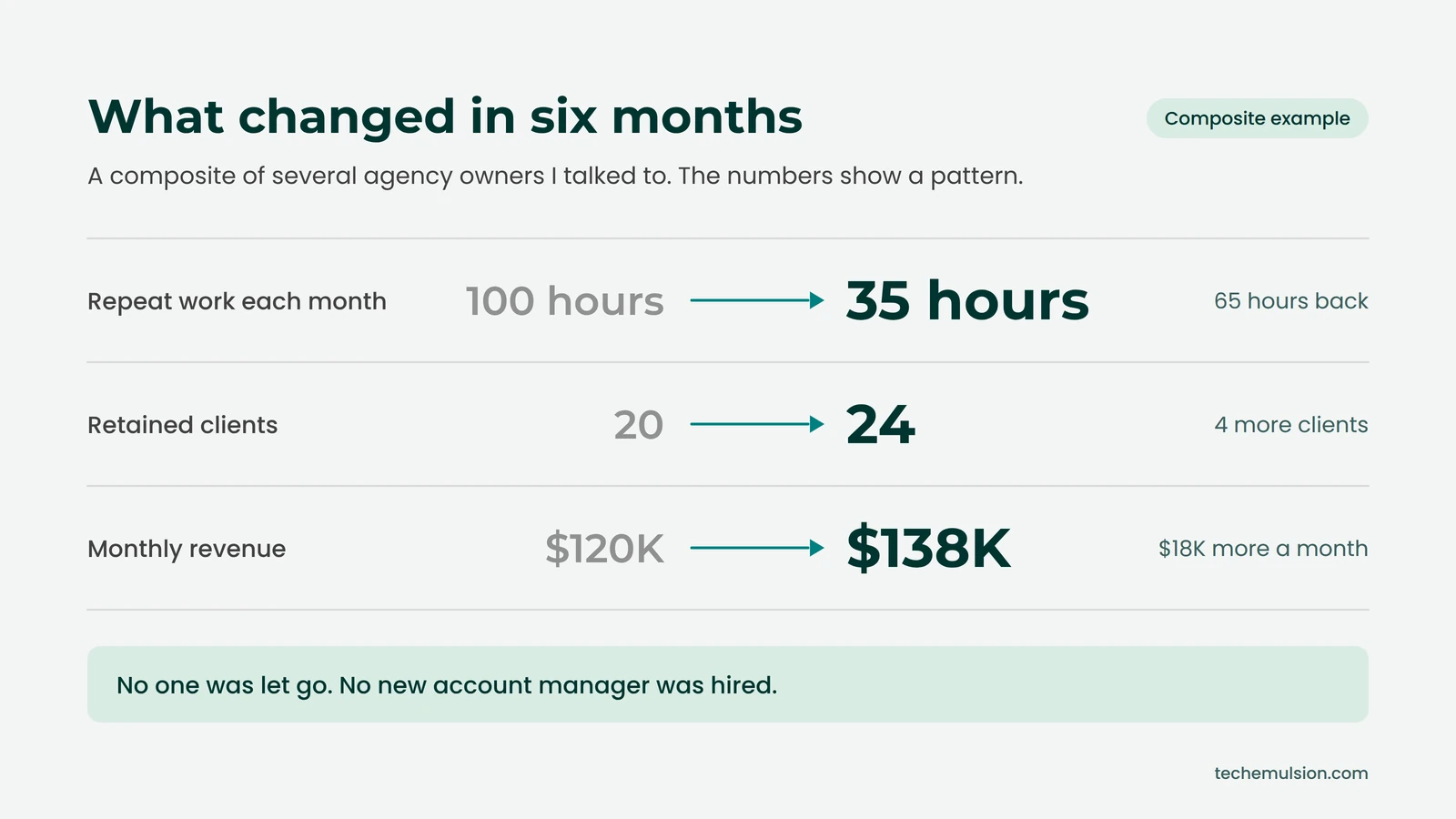
Picture a 12-person performance marketing agency doing about $120K a month across roughly 20 retained clients. It just lost a client worth about $8K a month. That client hired an internal marketing person and was already using AI for content drafts, reporting summaries, campaign analysis, and creative variations.
Around the same time, another client started questioning the price. Their logic was simple: if AI can draft the content, analyze the campaign, and summarize the numbers, why does this still cost what it used to?
So the owner looked inside his own agency. His team spent 80 to 120 hours a month pulling data from Google Ads, Meta, and GA4, preparing reports, writing client summaries, running quality assurance (QA) on campaigns, coordinating content, and moving information between systems. His real question became: if clients can do a big chunk of this themselves, what will they keep paying us for?
What changed when the owner treated AI as a delivery problem
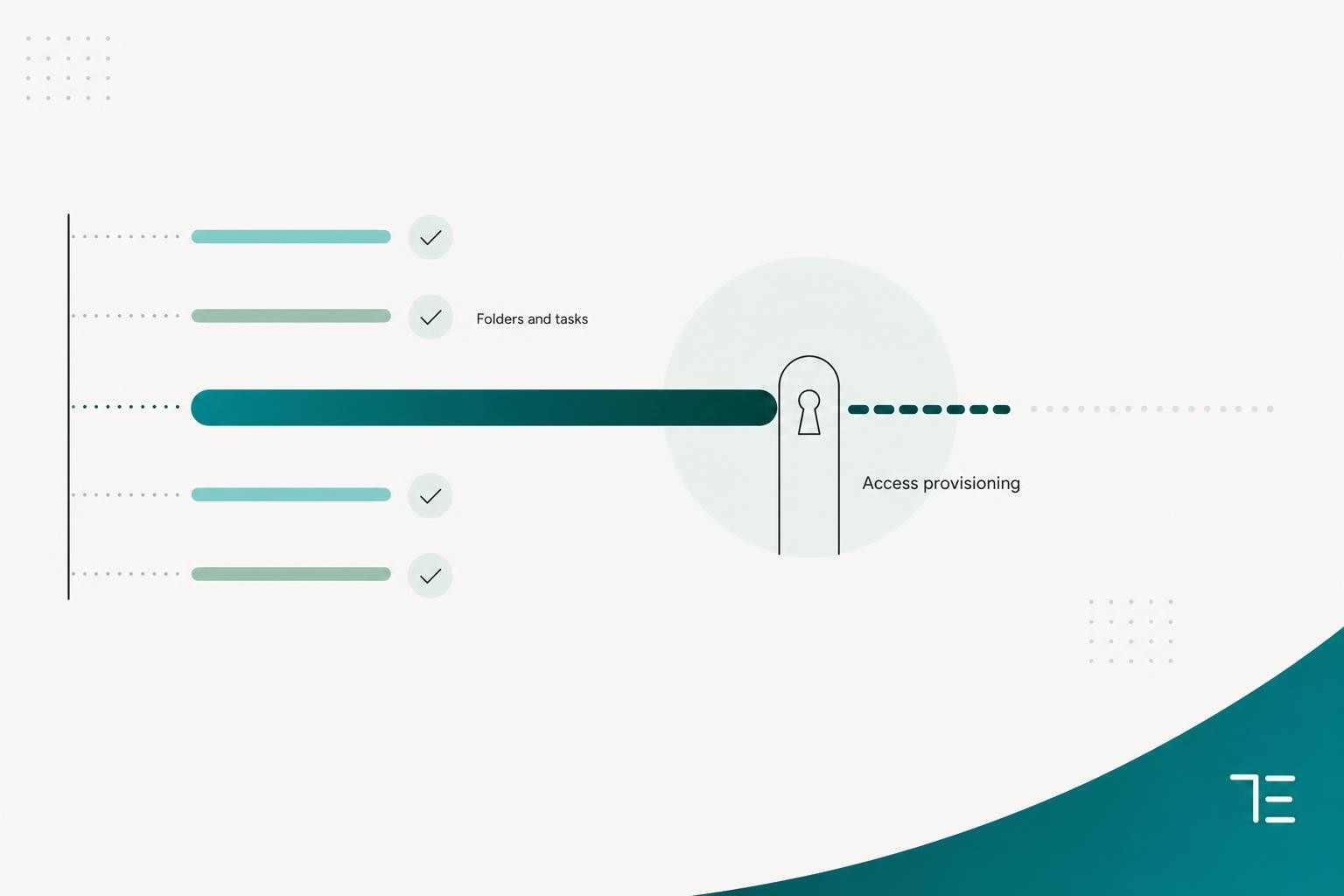
The first move was mapping the repetitive work. The team found about 100 hours a month tied up in reporting, campaign summaries, content coordination, QA checks, and moving data between platforms. Over the next couple of months, they automated the most predictable parts first.
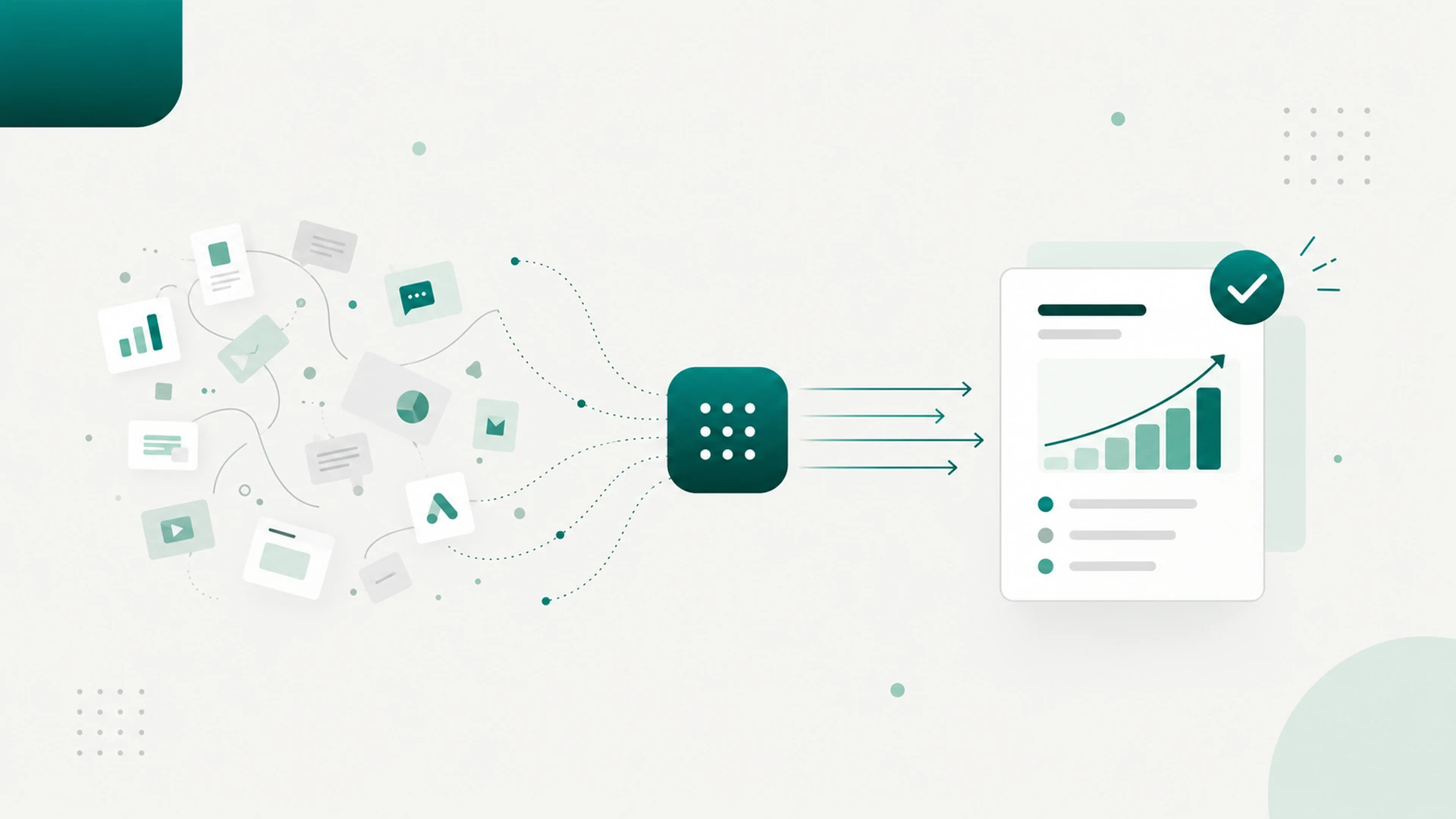
- Reporting data came in automatically from Google Ads, Meta, GA4, and the CRM.
- The numbers were validated before they reached the AI layer.
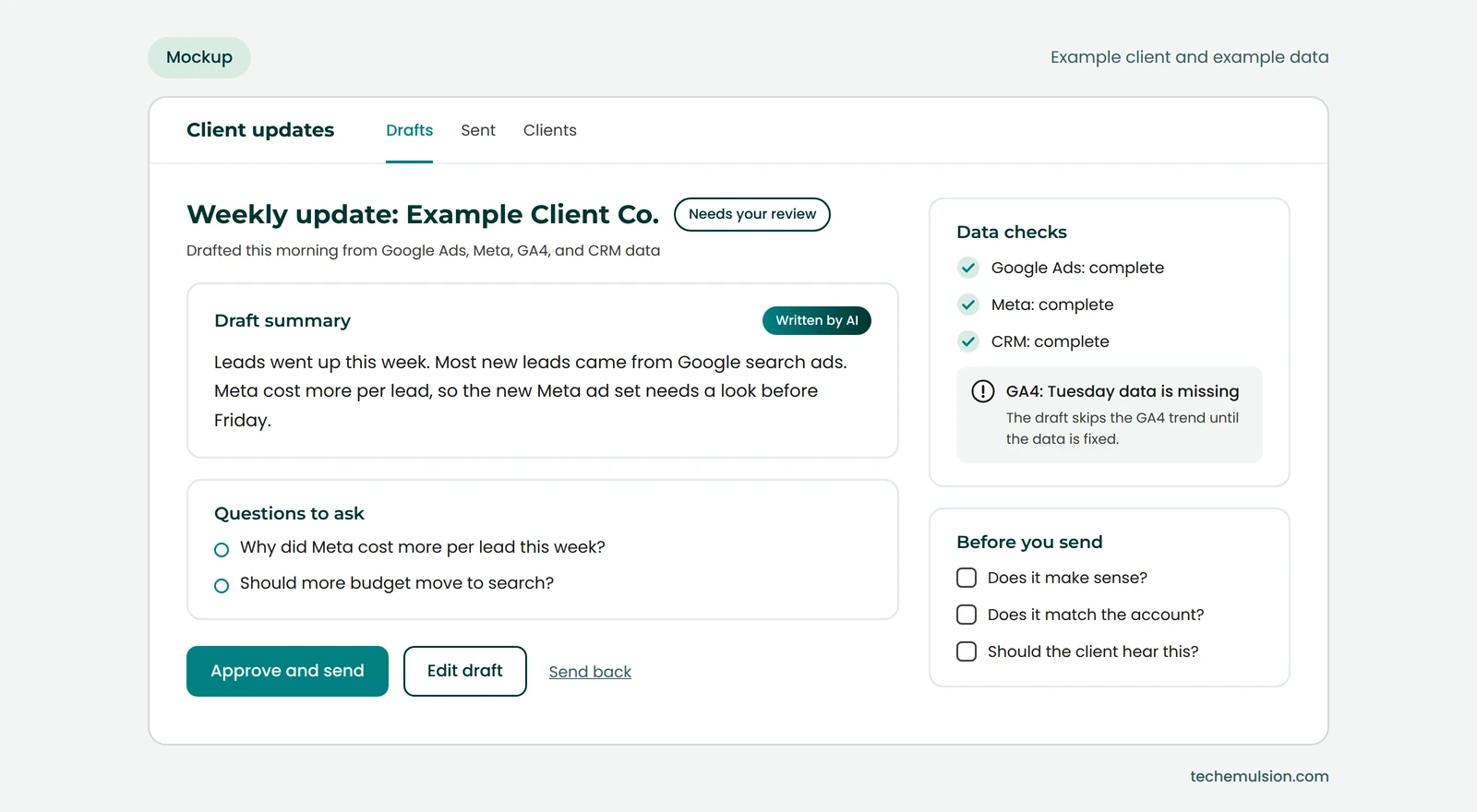
- A large language model (LLM) drafted each client summary, flagged unusual changes, and suggested questions for the account manager.
- Briefs, approvals, status updates, and first drafts moved into one content process, out of scattered Slack messages and spreadsheets.
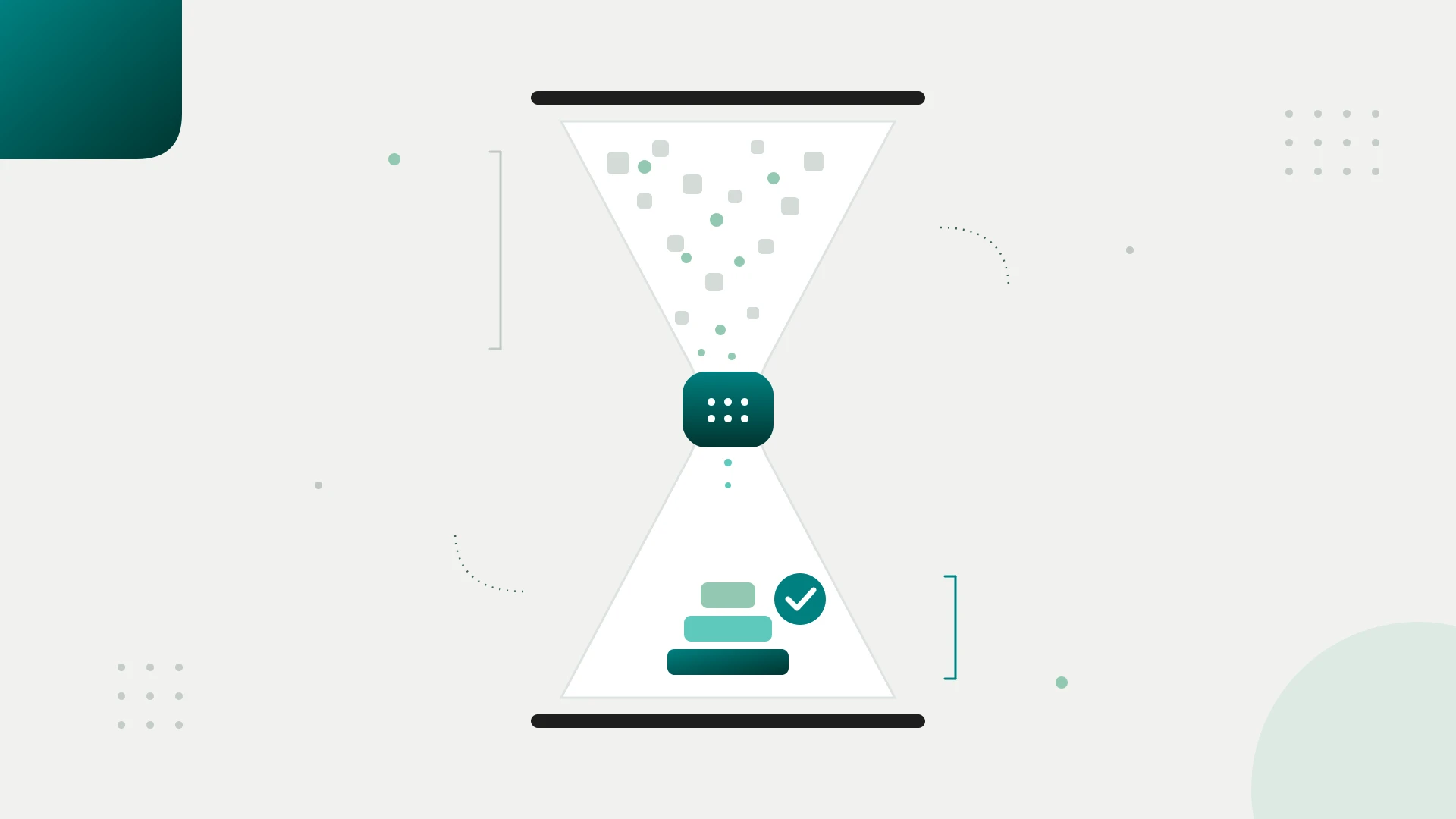
In this composite, repetitive work dropped from about 100 hours a month to about 35, freeing roughly 65 hours of team capacity every month. Nobody was let go. Account managers moved that time into strategy calls, campaign decisions, upsells, and proactive client communication.
Within about six months, the composite agency grew from roughly 20 retained clients to 24 without another account manager, and monthly revenue moved from about $120K to about $138K. New accounts ran on the automated system, so delivery didn't get noticeably heavier. Sales calls started leading with pipeline, acquisition cost, conversion rate, and the decisions the agency owned.
The biggest change was psychological. Before, every new client raised the question, "Do we have enough people to service them?" Afterward, the question became, "Can our system absorb another account?"
Can AI help an agency grow without hiring?
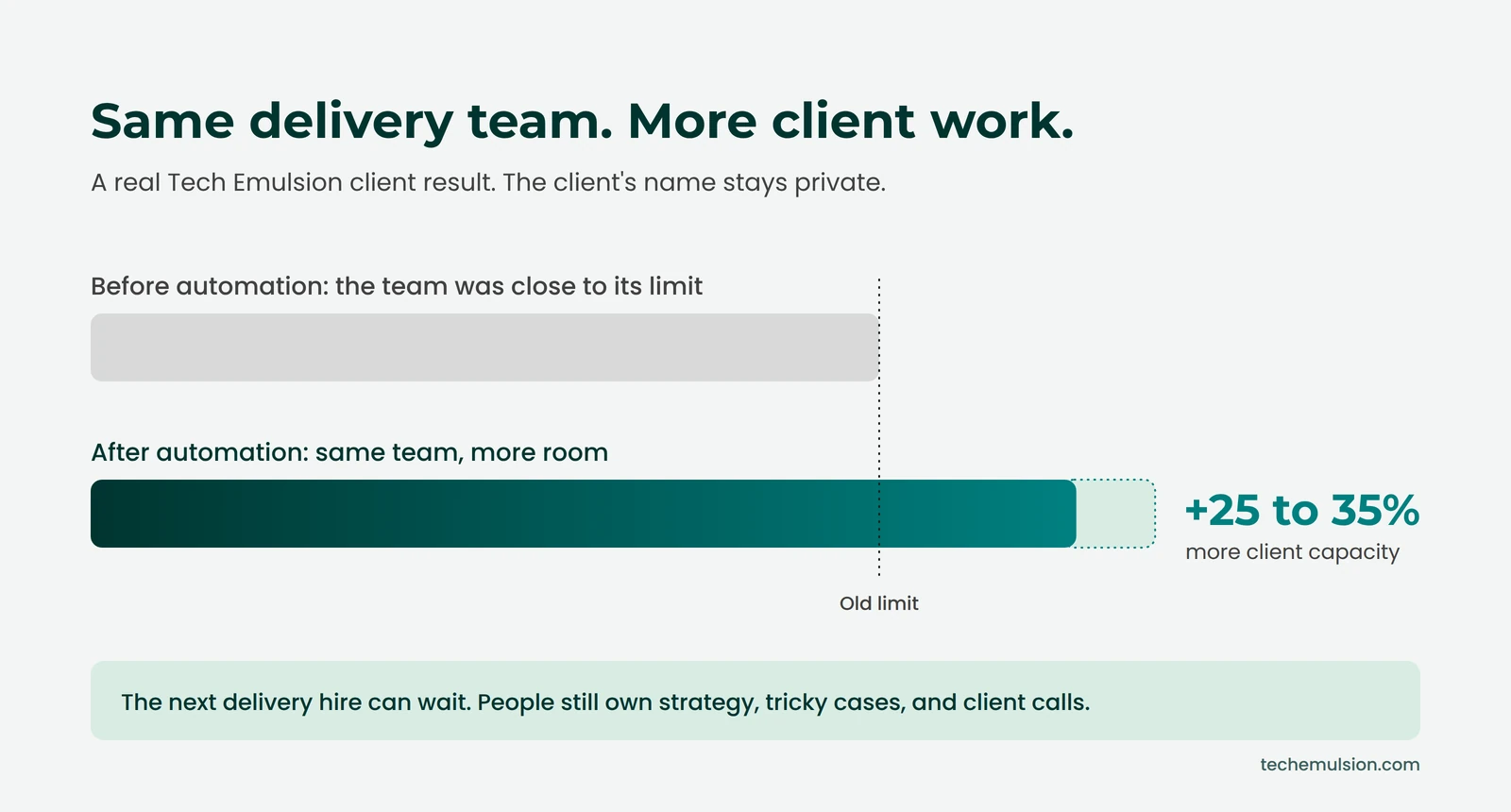
Yes, and that's the proof I care about most. At Tech Emulsion, we worked with a mid-sized marketing agency whose delivery team was close to its capacity ceiling. Demand was fine. Every new group of clients added reporting, QA, coordination, and account management work, so growth meant hiring.
We automated the repetitive delivery layer in stages over several weeks: data collection, transformations, routine checks, first-pass analysis, and draft client updates. People kept strategy, exceptions, campaign decisions, and client communication.
That Tech Emulsion implementation gave the agency's existing team roughly 25 to 35% more client capacity before another delivery hire became necessary. Saving someone a few hours is nice. Changing the relationship between client growth and headcount changes the business, and I expect the agencies that win the next five years to break that old link.
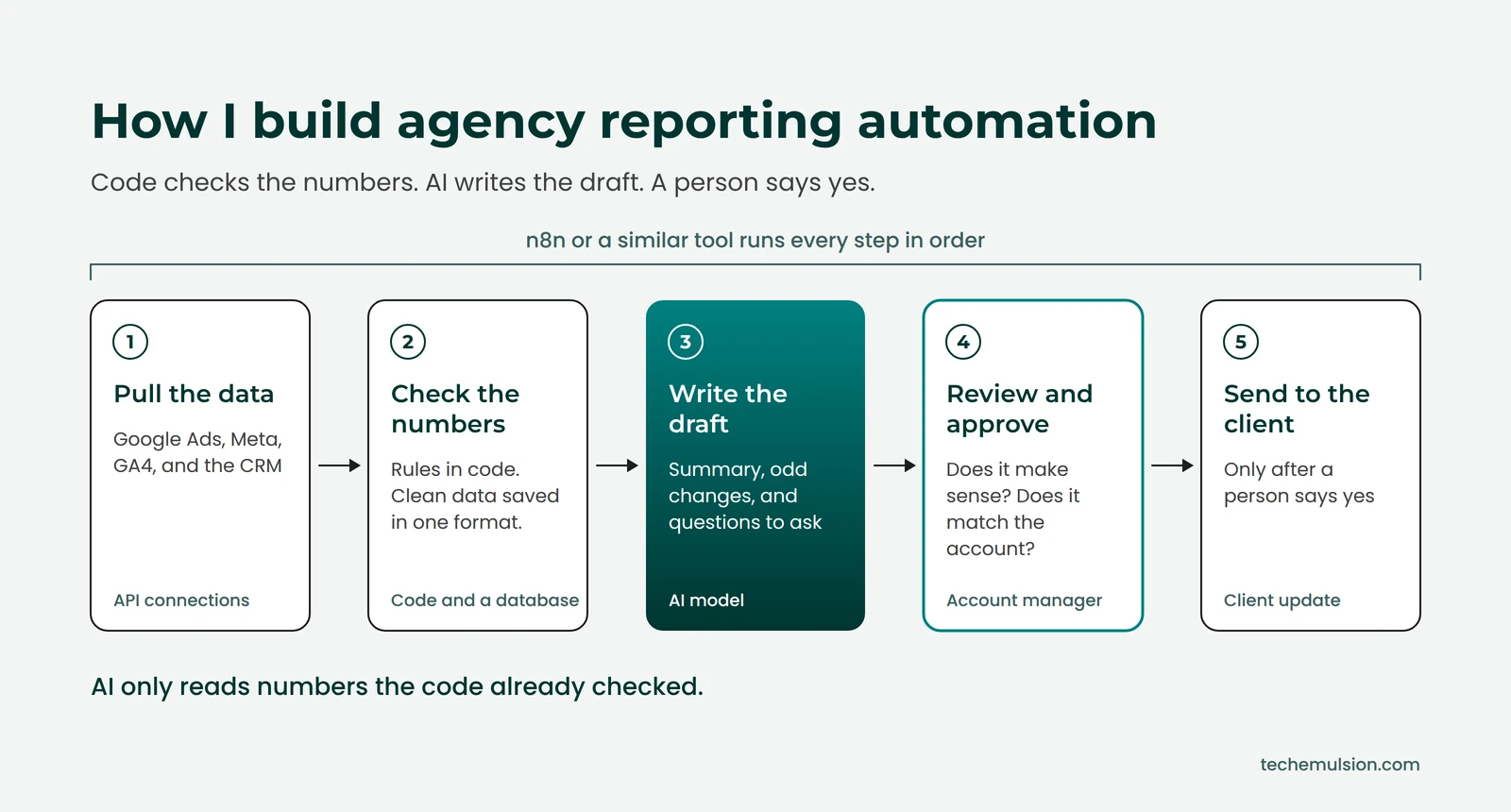
For this type of build today, I'd use n8n or a similar lightweight orchestration layer to run each workflow step in order. Direct API connections pull ad and analytics data, normal code handles validation and business rules, and a database stores normalized data (every platform's numbers in one consistent format) plus workflow state. The LLM only handles interpretation, anomaly summaries, and first-draft client updates.
Tech Emulsion is an official Anthropic Claude Partner, and the build order we keep coming back to is deterministic workflow, validated data, AI reasoning, then human approval where needed. Deterministic means the same input always produces the same output, which is how you want numbers calculated. Anything client-facing stays human-in-the-loop, so a person approves it before the client sees it.
For the technical detail, I documented a full reporting build in how to set up an AI marketing agent from scratch. That one is built around a real 25-client reporting agent.
What will the agencies that survive look like in 2031?
I expect the winning agency to look like a hybrid of a consultancy, a creative and strategy team, and a technology company. People stay close to the client, understand the business, set positioning and creative direction, make the strategic calls, and own the results. Underneath, workflows, agents, APIs, and software handle a large share of execution.
Some clients will bring execution in-house, like the one in the composite. Most business owners still want somebody accountable for making marketing work, and few want another technology stack to operate. AI lowers what it costs an agency to provide that accountability, which is why building the execution layer is the focus of our AI automation for marketing agencies.
The second group that survives is specialists. If you know marketing for dentists, SaaS companies, law firms, or home service businesses, you carry operating context an AI tool lacks. Generic execution commoditizes much faster than industry knowledge, distribution knowledge, judgment, relationships, and proprietary processes.
Specialization also makes automation easier to justify, because similar clients share workflows. That's the core of how agencies win by owning one industry's workflows.
What should you say when a client asks why AI didn't lower your price?
Here is roughly what I'd say: "You're right that AI has made parts of the work faster, and we use it for exactly that reason. You're paying us to make sure the right work gets done, the numbers are correct, the strategy makes sense, and someone is accountable for the result."
"Before AI, our team might spend three hours producing something and one hour reviewing it. Now AI might get us the first 70% in 20 minutes, so more of that time goes into analyzing the campaign, testing ideas, catching problems, and improving performance. Ideally, the efficiency gain means you get a better service for the same price."
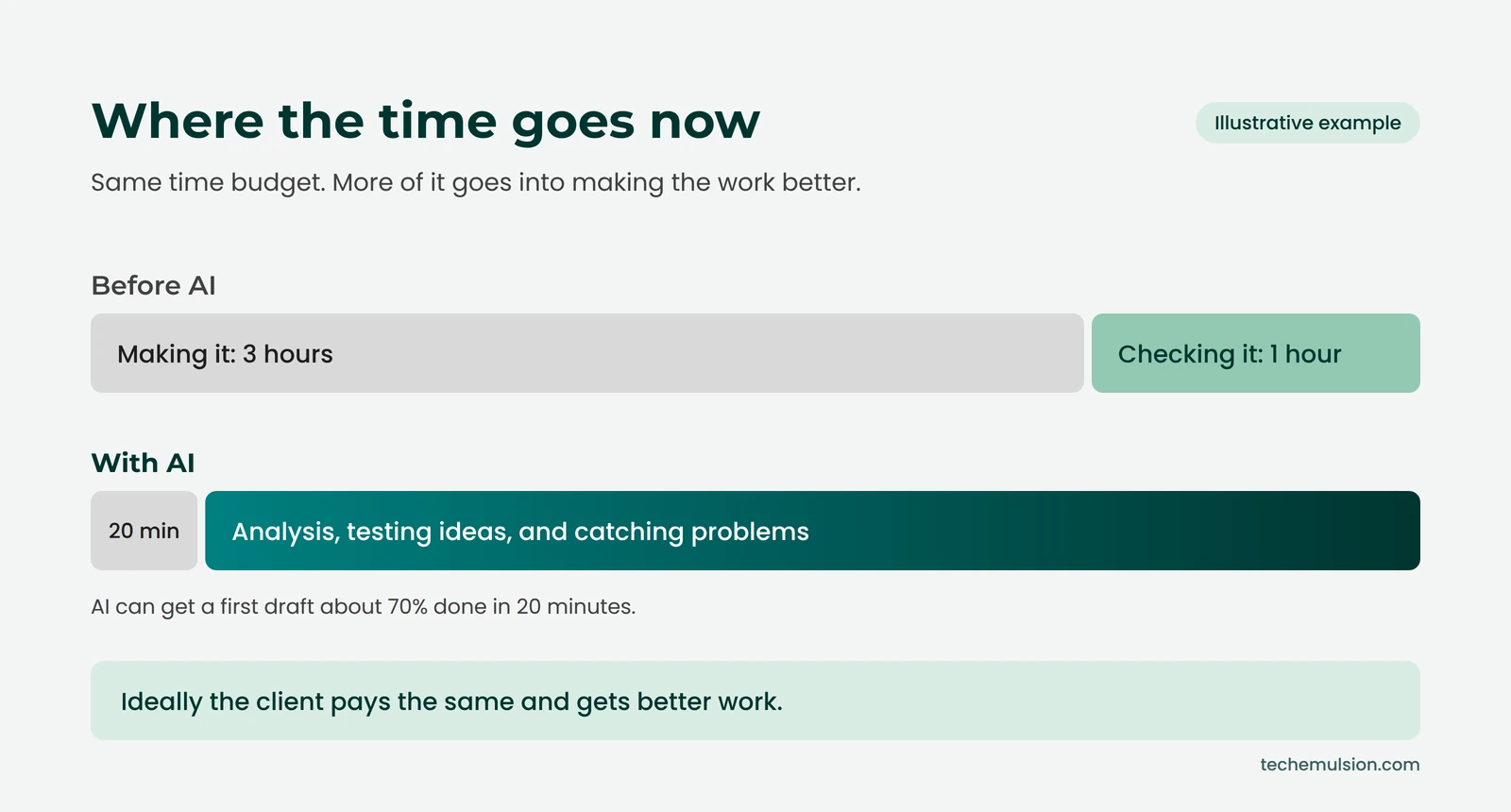
Be honest about the other side too. If all a client wants is the first draft, that should be cheaper now. Clients who hire you for decisions and accountability are paying for the part that still needs you.
What mistakes do agency owners make when they react to AI?
These are the mistakes I see most often. The first one is the biggest.
- They automate everything at once. Reporting, content, paid media checks, and client updates all get agents before anyone defines the process. When something breaks, nobody knows if the fault is the data, the workflow logic, the model, or the prompt.
- They start with the coolest use case. I've seen owners chase an "AI strategist" while account managers still pull numbers from Google Ads, Meta, GA4, and the CRM by hand every week. The boring automation is usually where the ROI is, so if someone spends hours copying numbers into reports, start with automated client reporting.
- They run AI on unvalidated data. If one source reports spend in dollars and another in cents, attribution windows (how long a platform credits a conversion after a click) differ, or an API returns partial data, the LLM will write a polished explanation for a false trend. Keep the math and validation in code so the model only interprets clean data.
- They treat the first draft as finished work. The most useful setup I've seen has AI handle the repetitive 60 to 80% of preparation while a person owns the last mile: does the conclusion make sense, does it match the account, and should the client hear it?
- They buy software before mapping the workflow. Some agencies collect five or six AI tools because each looked good in a demo, and six months later the team still works by hand. First ask who does the work, how much is manual, where the data comes from, and which part needs judgment.
- They cut headcount too early. If automation saves an account manager 20 or 30 hours a week, ask whether that person can now handle more accounts, improve retention, or support upsells. AI tends to change headcount economics before it changes headcount, and I went deeper on that in whether AI agents can really replace your marketing team.
The question behind every fix is the same: where is our operating model wasting human judgment? Start with one frequent, repetitive, measurable, and annoying workflow, and automate its deterministic steps before adding AI. It's less exciting in a demo and much more likely to still be running six months later.
When should an agency hold off on automating delivery?
Some agencies should wait, especially if the workflow still changes every week. These are the thresholds I use at Tech Emulsion, where similar clients means clients on the same service model:
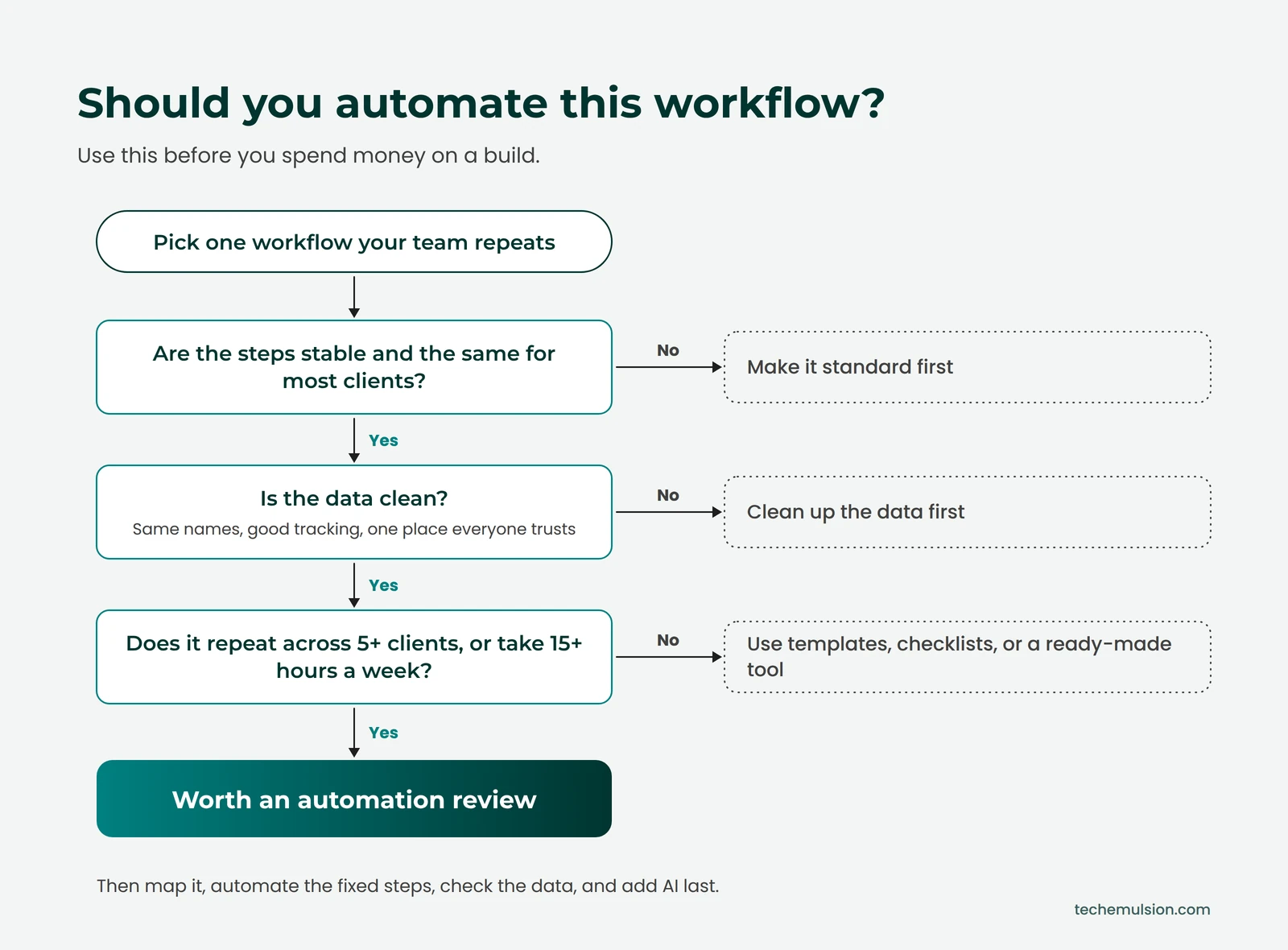
- 1 to 4 similar clients: keep delivery mostly manual, document the process, and use templates. Automating version one of a workflow means rebuilding it when your offer changes.
- 5 to 10 similar clients: start automating the obvious deterministic steps.
- 10 or more similar clients: custom workflows make much more sense, especially when reporting, QA, coordination, or data handling eats real team capacity.
- Under 5 hours a week on a workflow: usually not worth engineering unless the task is error-prone or business-critical.
- Under about 10 hours a week: use templates, better standard operating procedures (SOPs), or an off-the-shelf tool first. For reporting, weigh build vs buy for agency reporting before writing code.
- 15 to 20+ hours a week of repeatable work: actively look for an automation project, even with fewer clients.
Also hold off if delivery depends on subjective senior judgment, like bespoke brand strategy. Use AI there for research and first drafts, and keep the core work with people. The same goes for weak data discipline: inconsistent campaign naming, CRM stages that mean different things to different people, unreliable conversion tracking, or no agreed source of truth (the one system everyone trusts for a number). An LLM on top of that just makes the mess faster.
If every client has a different reporting format, tech stack, approval process, and campaign structure, standardize the service before you automate it. And if you're automating out of panic about headcount, hold off, because "how fast can I replace two account managers?" leads to bad system design.
My rule of thumb: if a workflow repeats across at least 5 clients or eats 15+ team hours a week, it deserves an automation review. If it meets neither threshold, improve the process first.
FAQ: the future of marketing agencies
Will AI replace marketing agencies?
AI will replace a large share of repeatable agency labor. Clients will still pay for strategy, niche expertise, creative judgment, and someone accountable for results. The agencies most at risk are the ones whose main advantage is people available to do repeatable tasks. I cover the three kinds of agency work and their replacement risk in will AI replace my marketing agency?
Should I lower my prices if my agency uses AI?
Only if your clients were buying hours. If they're buying pipeline, lower acquisition costs, or strategic judgment, put the efficiency gain into margin and capacity first. Then change what you sell so the price follows the outcome.
Should I tell clients my agency uses AI?
Yes. I'd open the pricing conversation by saying AI makes parts of the work faster and that's exactly why you use it. Selling labor while quietly using AI to reduce that labor is the position that gets harder to defend.
How long does it take to automate agency delivery?
In the Tech Emulsion implementation above, we automated in stages over several weeks. Start with one workflow, get it stable, then add the next. Automating everything at once usually creates a mess.
Where should you start with your own agency?
Pick the workflow your team repeats most across clients and put a weekly hour count on it. That number tells you whether you have an automation project or a process problem.
If you want a second opinion, book an Agency Automation Audit. We'll map your repetitive delivery work, put hours against it, and tell you plainly which workflows are ready to automate and which need process work first.