
OpenAI launched ChatGPT Dots on September 29, 2026. SpaceXAI shipped Grok Bot on August 11, and Anthropic began folding Cowork, its agent for longer multi-step work, into the main Claude app on September 16. A marketing agency owner now has three agents that keep working after the laptop closes, and one decision to make.
I'm Hassan, CEO of Tech Emulsion, and I have worked in AI for about ten years. This is Grok Bot vs Claude vs ChatGPT Dots for an agency owner who wants real client work done. I gave each agent one real task, timed the checking, and priced my own review time.
My experience with the three is uneven. Each one carries a label so you know how much weight to give it:
- Claude: substantial hands-on experience, about 18 months of regular use for code reviews, technical specifications, proposals, and long client documents. My time with its newer agent features is more limited.
- ChatGPT Dots: early hands-on impressions from a couple of days, on top of several years with ChatGPT.
- Grok Bot: limited experimentation supported by research, about two weeks of light use for company research and prospect briefs.
Tech Emulsion is an official Anthropic Claude Partner. Weigh my default pick with that in mind.
Grok Bot vs Claude vs ChatGPT Dots: which one should an agency pick?
For most small and midsize marketing agencies, Claude is the default pick because it fits everyday client delivery: proposals, market research, spreadsheet analysis, reports, and presentations. Pick ChatGPT Dots when your bottleneck is keeping ongoing work moving. Pick Grok Bot when you want several persistent bots with separate jobs and a person supervising them.
I put Claude first because those tasks sit close to an agency's revenue. My measure of value is how much usable client work the team produces after review and corrections are counted.
These three are general-purpose agents. For channel-specific tools, I have already compared the best AI agents for marketing tasks in 2026 one by one.
What are Grok Bot, Claude, and ChatGPT Dots?
An always-on agent is an AI system with its own cloud computer that keeps working between conversations and returns to you for decisions. ChatGPT Dots and Grok Bot are always-on agents, while Claude runs work task by task and on schedules.
Claude
Anthropic began merging Cowork into the main Claude app on September 16, 2026. Chat and agent work now share one conversation. Longer tasks keep running in the cloud after you close the laptop, and recurring tasks can run on a schedule. The rollout reaches Pro and Max plans first, with Team and Free plans to follow, so check that your account has it.
ChatGPT Dots
OpenAI announced ChatGPT Dots on September 29, 2026. A dot runs on GPT-6 Astra, has its own cloud computer, and connects to more than 4,000 apps by way of plugins. You start with one primary dot, reachable in ChatGPT, Slack, or Teams, and it comes with Pro and Business Premium plans.
Grok Bot
SpaceXAI launched Grok Bot in beta on August 11, 2026. You get a roster of persistent bots that sign into your tools, message each other, and learn a workflow by watching you do it once. Access comes with SuperGrok and paid Cursor plans, and enterprise access is by waitlist.
What happened when I gave each agent real work?
These are field notes from me, Hassan, running three different tasks at Tech Emulsion. The tasks differ, so the times describe one operator's experience on real work.
Claude: an implementation plan from discovery notes and a codebase
I connected Google Drive for the discovery documents and GitHub for the relevant repository files, then asked for an implementation plan with missing requirements flagged. The only snag was authorizing the private repository and selecting the right folders.
The structure was useful, and it still needed 30 minutes of checking and fixing. Claude treated unresolved requirements as settled. It assumed account owners and staff would share the same permissions, although the discovery notes suggested different access levels. It also read one change as frontend work when it needed an API change and a database migration, so I added migration, rollback, and acceptance criteria.
ChatGPT Dots: a progress summary from project documents
I connected Google Drive, supplied a project brief and status documents, and asked for completed work, outstanding decisions, blockers, and owners. My first Drive connection used the wrong Google account, so I reconnected and gave it exact document links.
Checking and fixing took 15 minutes. The dot mixed an older status update with newer information. It marked one item as completed because development was finished while client approval was still outstanding, and it listed an unresolved dependency without saying that nobody owned the next action.
The summary became useful once I separated three statuses: built, reviewed, and approved. Whether a dot holds an ongoing responsibility reliably over several weeks is still an open question for me.
Grok Bot: a company brief from a public website
I gave a bot a company website and asked what the business sells, who it serves, and where its operations might be stuck. It worked in its own browser on public sites, with no private business accounts connected.
Checking and fixing took 20 minutes. The bot repeated the company's marketing language too confidently, and a broad service claim became an assumption about what the company delivers internally. It presented plausible operational problems as established facts, so I kept the confirmed company information and turned the proposed pain points into discovery questions.
The pattern across all three
Each agent promoted something unconfirmed to something settled. Claude turned an open requirement into an implementation decision. The dot turned built into completed, and Grok Bot turned marketing copy into fact.
The review job is therefore the same on every tool: trace each confident statement back to its source. In my three tests that took 15 to 30 minutes per task. It is the same discipline behind agentic AI engineering at Tech Emulsion: verify the inputs before trusting a polished output.
How much setup and checking does each one need?
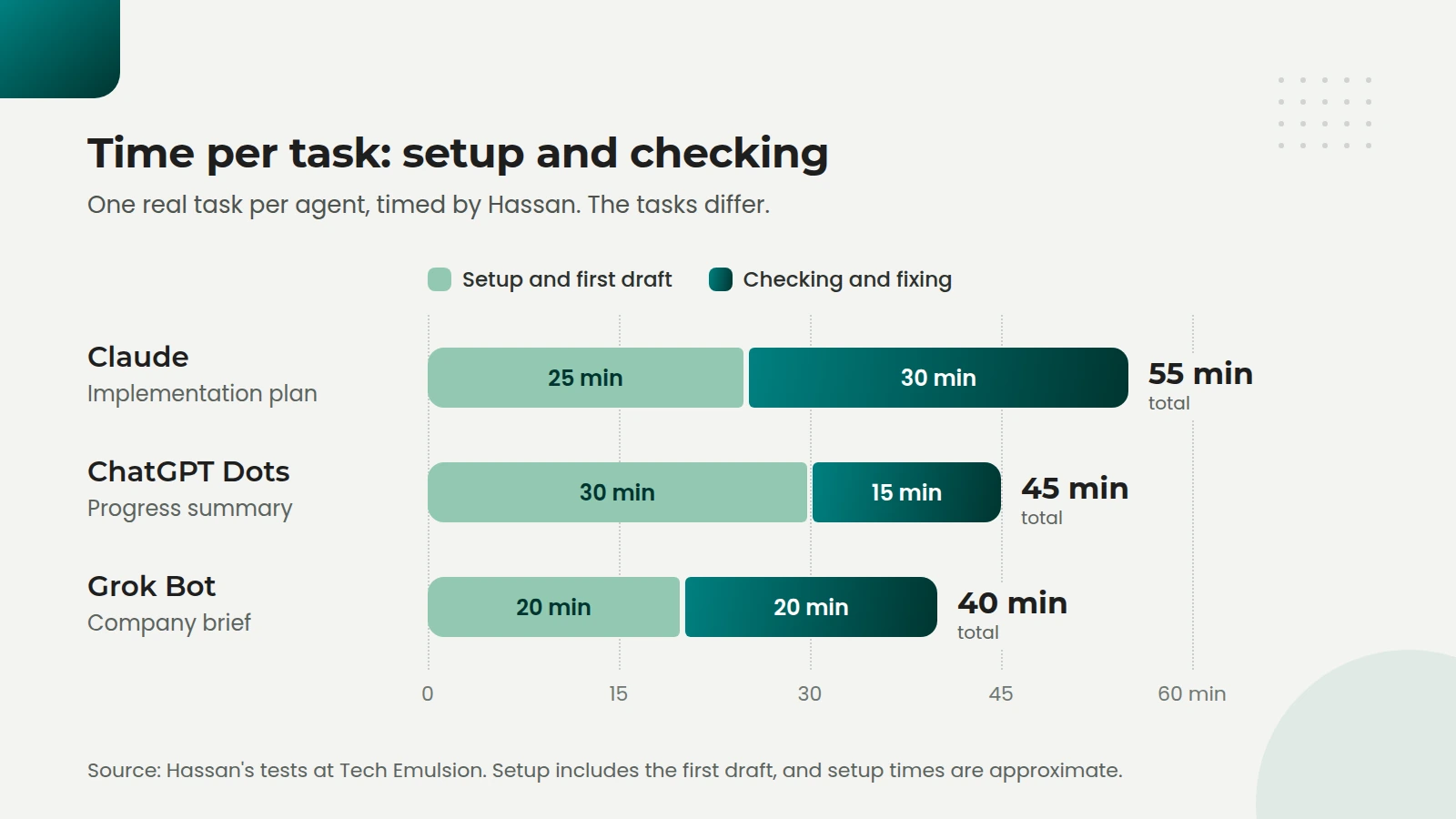
Here is the full timing for each task. Setup includes the first draft and assumes an eligible account with the feature already available:
- Claude implementation plan: about 25 minutes of setup, 30 of checking and fixing, about 55 in total.
- ChatGPT Dots progress summary: about 30 minutes of setup, 15 of checking and fixing, about 45 in total.
- Grok Bot company brief: about 20 minutes of setup, 20 of checking and fixing, about 40 in total.
What does each agent cost once you count your own time?
These are the plans I used. Prices are the published monthly rates in October 2026:
- Claude Max 5x: $100 a month.
- ChatGPT Pro 100, with the first dot included: $100 a month.
- SuperGrok, with Grok Bot included: $30 a month.
That is $230 a month for all three, before taxes and additional usage. Max 5x is my heavier-use choice, and the implementation plan would run on a smaller plan.
The larger cost is the owner's time. I price review time at $100 an hour, a modeling assumption applied equally to all three that says nothing about anyone's salary or billing rate. Here is what each task cost at that rate:
- Claude implementation plan: 30 minutes of review, $50.00.
- ChatGPT Dots progress summary: 15 minutes of review, $25.00.
- Grok Bot company brief: 20 minutes of review, $33.33.
Two tasks like the Claude plan cost as much in review time as a month of Max 5x. One Grok Bot brief costs more in review time than a month of SuperGrok. For a monthly figure, add the subscription, any additional usage charges, and your hands-on hours for prompting, checking, corrections, and approvals multiplied by $100.
Review time is one reason these agents change an agency's economics before they change its headcount. I made that case in full when I asked whether AI agents can really replace your marketing team.
What should an AI agent be allowed to touch inside an agency?
My rule at Tech Emulsion is the same for all three: broad access to prepare work, narrow authority to act. Anything that spends money, changes a live client system, or communicates externally needs a person's approval first. That is human in the loop in practice.
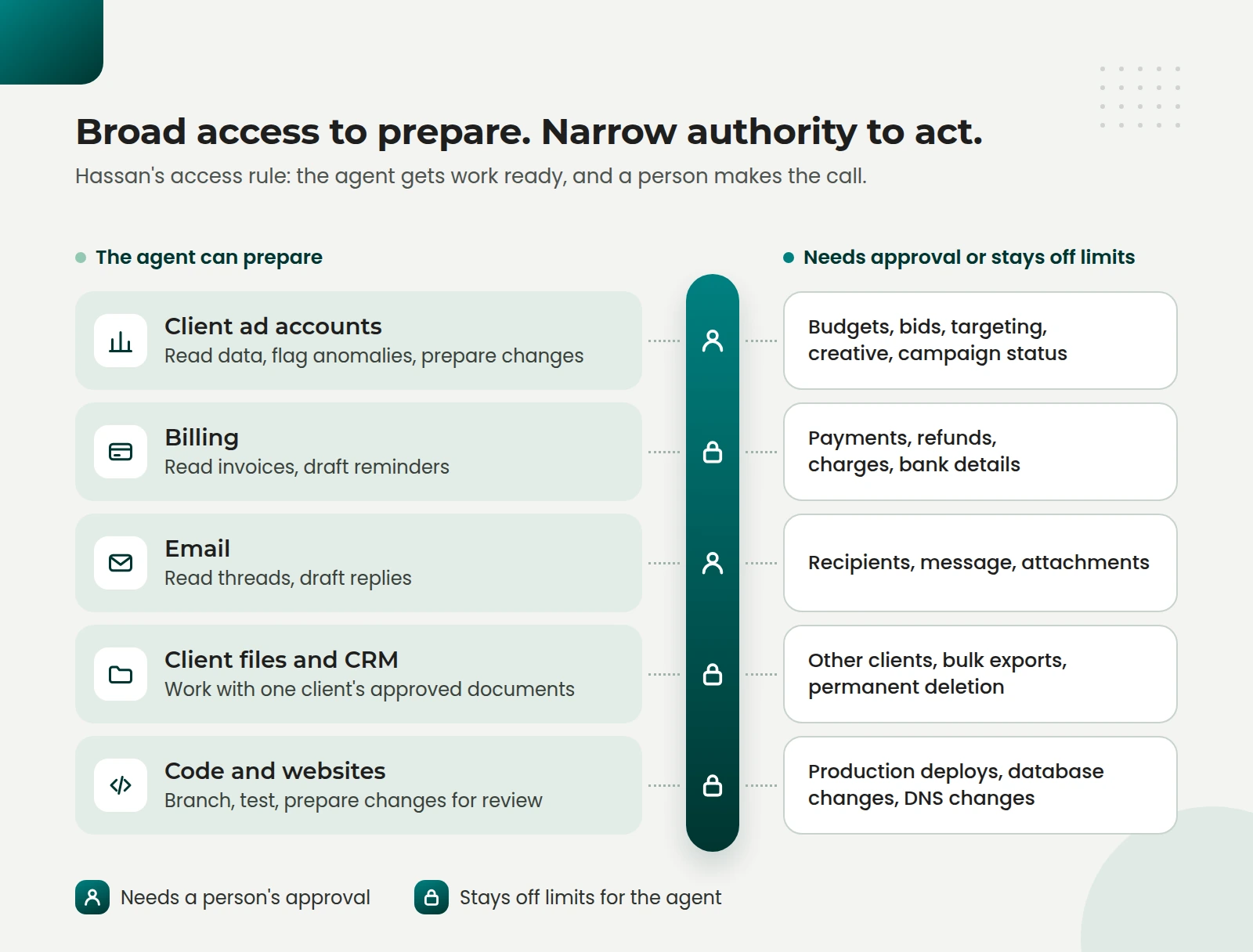
- Client ad accounts: read data, flag anomalies, and prepare changes, with a person approving any change to budgets, bids, targeting, creative, or campaign status.
- Billing: read invoices and draft reminders, with no autonomous payments, refunds, charges, or changes to bank details.
- Email: read threads and draft replies, with a person approving recipients, message, and attachments before anything is sent.
- Client files and CRM: work with one client's approved documents, with no access to unrelated clients, bulk exports, or permanent deletion.
- Code and websites: inspect a repository, branch, test, and prepare changes for review, with no autonomous production deploys, database changes, or DNS changes.
Some work can run without approval after testing: a draft weekly report, an internal task list, or a routine digest to one internal channel. Client and prospect emails keep approval on, because a well-written message can still promise the wrong deadline, disclose another client's information, or reach the wrong person.
I enforce these boundaries with account permissions and restricted connections. If I cannot enforce a boundary, I leave that account disconnected. ChatGPT Dots has Custom Rules for this, where you decide per action whether the dot acts alone, asks first, or hands the task back to you. Permission to research a problem never becomes permission to fix it in a live account.
Client separation has to be real. Grok Bot's documentation says every bot on one user account works on the same cloud computer, so files, browser sessions, and sign-ins are shared across the roster. A separately named bot for each client therefore creates no separate client environment.
When do Claude, ChatGPT Dots, and Grok Bot stop being enough?
The line for me is a repeatable client service that needs consistent calculations, controlled access, and a reliable way to handle failures. Weekly reporting across many clients is the clearest example, and it is the workflow behind automated client reporting.
Softmax Data built a reporting workflow for the agency Flywheel Digital and reports that, across roughly 30 clients, weekly reporting work fell from about 60 hours to about 5. The workflow pulls ad, ecommerce, and CRM data, drafts client-specific analysis, and publishes drafts into Notion for account managers to approve before delivery.
Those are vendor-reported results from Softmax Data's own project, and Tech Emulsion had no part in it. Flywheel Digital's CEO, Michael Steele, is quoted on Softmax Data's site praising the work.
The reason to build something custom is the coordination around the report. Before I recommend a custom build, I look for a recurring operational requirement:
- Consistent calculations: agreed definitions for revenue, conversions, attribution windows, and reporting periods.
- Client separation: each report uses the correct accounts, permissions, templates, and business context.
- Data checks: missing or stale data stops the affected report and alerts someone.
- Recovery: failed connections retry, and reruns produce no duplicate deliveries.
- Approval and history: an account manager approves each report, with a record of sources and changes.
If your existing tools meet those requirements, keep using them. Build the missing pieces when they fall short. Client count alone is a weak trigger, and build vs buy for agency reporting comes down to your reporting rules and operational requirements.
Claude, ChatGPT Dots, and Grok Bot can still handle analysis and drafting inside that workflow. The recurring data collection, calculations, checks, and delivery controls belong in a managed system, which can be a small integration and workflow layer around the tools you already pay for. That system needs an owner after launch, which is the job of AI ops and ownership.
Which business profile fits each agent?
Each agent suits a different agency profile. Choose one, tied to the work you need done:
- Claude fits a small or midsize agency that turns discovery notes into proposals, researches client markets, analyzes spreadsheets, and prepares reports or presentations.
- ChatGPT Dots fits an owner who already works heavily in ChatGPT and needs help tracking client decisions, preparing meeting briefs, and following up as project information changes. Treat it as a pilot.
- Grok Bot fits an agency that wants several persistent bots with separate jobs, such as a prospect researcher, an outreach drafter, and an account monitor, with one person supervising them. I base this on its documented design.
When that work is a repeatable client service, the agent becomes one part of a larger system. AI automation for marketing agencies covers the rest: integrations, checks, approvals, and delivery.
FAQ: Grok Bot, Claude, and ChatGPT Dots for agency owners
Is ChatGPT Dots better than Claude for a marketing agency?
I default to Claude for client deliverables such as proposals, research, and reports. Pilot ChatGPT Dots when your problem is keeping ongoing work moving across connected tools, and treat my Dots view as an early impression after a couple of days.
How much do Grok Bot, Claude, and ChatGPT Dots cost per month?
In October 2026, the plans I used cost $100 a month for Claude Max 5x, $100 for ChatGPT Pro 100 with the first dot included, and $30 for SuperGrok with Grok Bot included. Claude Pro costs $20 a month, and your own review time is the larger cost at $100 an hour.
Can I use ChatGPT Dots in the UK or Europe?
On the Pro plan, ChatGPT Dots launched outside the European Economic Area, Switzerland, and the UK. OpenAI says Business Premium users get Dots in all supported ChatGPT regions, and Enterprise workspaces can try the beta once an admin enables it.
Do I need a custom AI agent, or is a subscription enough?
A subscription is enough while a person reviews each output and the work is drafting, research, or analysis. Move to a custom build when a recurring client service needs consistent calculations, separate client permissions, data checks, failure recovery, and approval history.
Where do you go from here?
If you run an agency and want a second opinion on which agent fits your work, book an intro call with Tech Emulsion. Bring one workflow that eats your team's week. We will tell you plainly whether a subscription agent covers it or whether a small custom layer is worth building.