
Every roundup of the best AI agents for marketing tasks in 2026 ranks tools by feature count. That is the wrong lens for an agency owner. I'm Hassan, CEO of Tech Emulsion, and this comparison is built around a different question: which agent can reliably take over one expensive, repeatable workflow inside your agency without embarrassing you in front of a client?
Two of the ten tools below, HubSpot Agent Hub and Jasper Marketing AI Agents, Tech Emulsion has run inside live agency work. The other eight are covered from product research, vendor documentation, demos and published customer results. I say which is which in every section.
What are the best AI agents for marketing tasks in 2026?
The best AI agents for marketing tasks in 2026 are HubSpot Agent Hub for CRM-driven campaigns, Jasper Marketing AI Agents for campaign briefs and content volume, Search Atlas OTTO for SEO fixes, Madgicx for Meta ads, and Google Ads Ask Advisor for search. Pick by the workflow you want to remove, then measure hours before and after.
That short answer skips Salesforce Agentforce, Semrush, Writesonic, Albert.ai and Omneky. All five appear below. Each fits a narrower agency profile, so they belong in the comparison without belonging in a one-line answer.
How should an agency owner pick an AI marketing agent?
Most agency owners pick AI agents the way they picked SaaS: by the length of the feature list. A tool that does 25 things at 60% quality is usually worth less than one that does a single $3,000 per month workflow very well. Begin with the workflow and its cost, which is the same argument I make when I say agencies should start with the workflow and its cost.
The market is also chasing full autonomy. I think that is the wrong goal for agencies. Marketing is full of judgment calls around positioning, brand, client politics, budgets, compliance and taste. An agent that removes humans from all of them automates mediocre decisions faster. The sweet spot I aim for is about 80% machine execution and 20% human judgment.
Here is what that looks like in practice. I would rather have an agent that researches 200 prospects, drafts personalized outreach, updates the CRM and flags the best 20 for a salesperson than one that emails all 200 on its own and puts the client's reputation at risk.
Content generation is becoming a commodity. Every platform below can write a blog post, a social post or an ad variation. The value sits in everything around the generation: context, decision, execution, measurement and feedback. "Write 10 Facebook ads" is cheap. An agent that notices Creative A's CPA rose 35%, reads the last 30 days, drafts five replacements built on the winning angles, sends them for approval and logs the experiment is hard to replace.
I evaluate every marketing agent on four numbers:
- Human hours before
- Human hours after
- Error or rework rate
- Business outcome produced
If you cannot measure the first two, you do not yet know whether the agent is useful. Judge on economics. A senior copywriter at 6 hours costs about $360 at $60 per hour. AI plus 45 minutes of senior review runs roughly $50 to $70 including tool cost. If the output is 95% as good, that is a strong business decision.
HubSpot Agent Hub: what Tech Emulsion ran with an agency client
Tech Emulsion worked with an agency that manages marketing for a B2B cybersecurity SaaS company. The client was launching a compliance product aimed at IT directors at companies with 100 to 1,000 employees. Before agents, one person spent two to four hours per campaign researching the angle, writing a brief, drafting a landing page, writing three emails, creating LinkedIn posts, segmenting leads and configuring follow-ups.
The agency gave Agent Hub a single instruction: generate pipeline for the compliance product, targeting IT directors at companies of that size. HubSpot's documented flow is Campaign Agent plans, Content Agent creates, Nurture Agent converts. Campaign Agent turned the goal into a plan with channels, messaging and assets. Content Agent produced landing page, blog and social drafts in the client's brand voice. Nurture Agent personalized follow-ups from each contact's CRM record.
Content Agent is the part that felt agentic rather than a chat window bolted onto a CRM. For an SEO article it researches the brand and ICP, reviews existing content, checks keyword volume and difficulty, researches competitors, builds the structure, drafts the article and meta description, adds links, matches brand voice and checks the draft against a quality rubric. Budget 30 to 90 minutes of expert editing per article after that, depending on the subject. The same brand-trained approach is how we run our AI content engine for agency clients.
The real advantage is context. With an external model you paste in the ICP, the leads, past emails, brand voice and campaign every time. Inside Agent Hub that data is already there, which matters when an agency manages thousands of contacts and dozens of campaigns.
Where it falls short: strategy and quality control stay human, and the whole thing loses most of its appeal if your client data lives outside HubSpot or your main need is autonomous Google and Meta ad buying.
Jasper Marketing AI Agents: measured results over 12 weeks
The same agency ran a 12-week test of Jasper Marketing AI Agents on the cybersecurity client's compliance monitoring launch, targeting IT directors at companies with 200 to 2,000 employees. Each campaign needed roughly 15 assets: a brief, a landing page, two nurture emails, two blog pieces, five LinkedIn posts and four Google and LinkedIn ad variations.
Before Jasper, a strategist, copywriter and editor spent about 26 human hours per campaign. Research and brief took four hours, messaging three, landing page four, emails three, social three and a half, ads two and a half, and editing and brand review six.
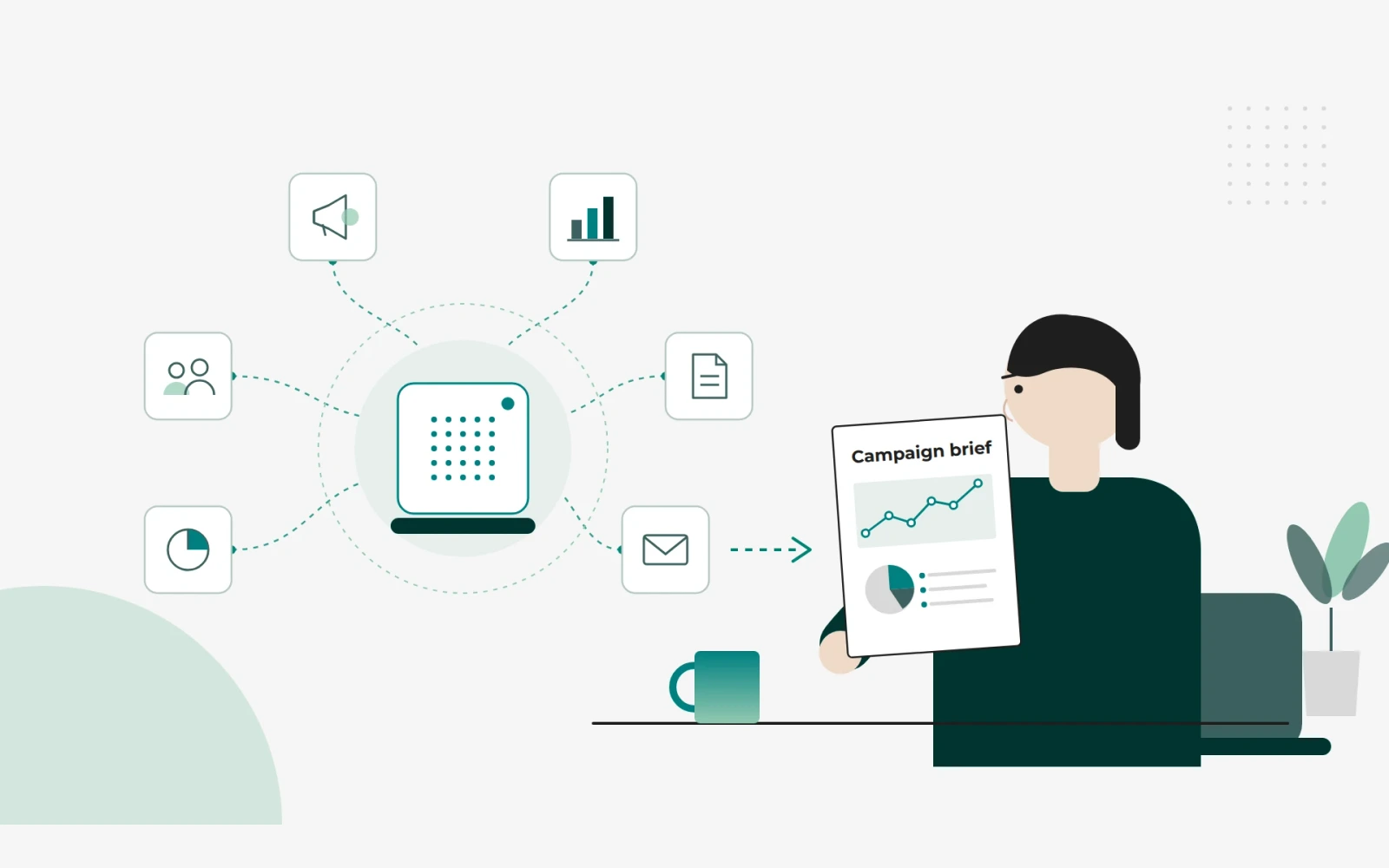
The agency loaded the client's positioning, audience data, product documentation, past campaigns, style guide and brand voice into Jasper. Agents drafted the brief, the landing page, email variations, social repurposing and paid ad copy. Humans kept positioning decisions, fact checking, final editing and approval.
After Jasper, the same campaign took about 10.5 human hours: two for strategy and agent instructions, one to review the brief, two on the landing page, one each on emails, social and ads, and two and a half on the final fact and brand review. Generation runs took a few minutes each. Nearly all of the 10.5 hours went to review and strategy.
Over 12 weeks the agency ran six campaigns and 90 assets. Production time fell from 26 to 10.5 hours per campaign, a 60% reduction. Total human hours dropped from 156 to 63, returning 93 hours to the team. At the agency's blended labor cost of roughly $60 per hour, and with around $40 of Jasper cost allocated per campaign, cost per asset went from about $104 to about $45, a 57% reduction.
Demo bookings influenced by these campaigns went from 74 to 89 against the prior 12 weeks, and landing page conversion moved from 3.8% to 4.4%. The agency did not credit Jasper for those numbers. Messaging, targeting, spend, seasonality and creative testing all changed in the same period. The result they could stand behind was production efficiency.
Jasper's best work was repurposing, first drafts, brand consistency and creative volume, producing 10 to 20 variations a marketer could shortlist in minutes. It also invented unsupported security claims, sounded more confident than the product evidence justified, repeated ideas across social posts, produced generic positioning and missed the difference between security buyers and general IT buyers. Nobody let it publish directly. It produced the first 70 to 80% of each asset and editors handled the rest. That is also the design behind our ad creative engine, which generates variations and feeds performance data back before anything exports to Meta or Google.
Eight more marketing agents worth testing
Tech Emulsion has not run these eight inside a live agency account. Everything below comes from product documentation, demos, published feature sets and customer case studies, so you will see no "we found" claims and no before and after numbers.
Salesforce Agentforce Marketing
Best for enterprise campaigns, audience creation, personalization and paid media where the client already runs on Salesforce. It plans and optimizes campaigns inside the Salesforce data model. Watch the price and the dependency on clean Salesforce data. Evidence level: vendor documentation and Salesforce customer stories.
Semrush AI Marketing Agent
Best for campaign research, competitor research, content and multi-step marketing workflows for agencies already paying for Semrush. It chains tasks that used to mean hopping between Semrush reports. Watch for output that stops at recommendations rather than deployed changes. Evidence level: vendor documentation and demos.
Search Atlas OTTO SEO
Best for technical and on-page SEO where you want fixes deployed, since OTTO pushes changes to the site rather than listing them. That includes content optimization and internal linking. Watch the risk of automated changes landing on a client site without review, and set approval gates first. Evidence level: vendor documentation and published customer results. Agencies that want SEO at scale with human checkpoints usually pair this kind of tool with programmatic SEO pipelines.
Writesonic SEO AI Agent
Best for keyword research, competitor analysis, content strategy and visibility in AI search results, which Writesonic frames as GEO. Watch for the same content issues we saw with Jasper: generic angles and confident claims. Evidence level: vendor documentation.
Google Ads Ask Advisor
Best for Google Ads analysis, troubleshooting and optimization inside the account. It answers questions about performance and suggests changes. Watch for recommendations that favor Google's spend goals over the client's CAC target. Evidence level: Google documentation.
Madgicx AI Marketer
Best for Meta ad optimization, budget decisions, account audits and creative analysis at agencies heavy on Facebook and Instagram. Watch the dependence on Meta API access and the limited value for search or LinkedIn heavy clients. Evidence level: vendor documentation and published customer results.
Albert.ai
Best for autonomous media buying across paid search, social and programmatic at brands with real budgets. This is the most autonomous option on the list, and that is the concern: budget moves happen without a human deciding each one. Evidence level: vendor documentation and case studies.
Omneky Agent
Best for generating, launching, analyzing and optimizing ads across Meta, Google, TikTok and other channels. Watch for creative that drifts off brand at volume and for the approval layer you will need to add. Evidence level: vendor documentation.
What agency owners ask before they adopt marketing agents
Three objections come up on nearly every sales call. Under all three sits ROI.
What if the agent gets something wrong?
Automate the work before you automate the consequence. The agent pulls Google Ads and Meta data, calculates performance, drafts the weekly report and flags anomalies. An account manager approves before the client sees it. That removes 70 to 90% of the manual work while the team stays at the approval layer. Measure the error rate for a few weeks and expand permissions from there. This is how we design automated client reporting across Google Ads, GA4, Meta, LinkedIn and TikTok.
Will this hurt client trust if they are paying for humans?
Clients pay for strategy, accountability, judgment and results. If reporting drops from 10 hours to two, those eight hours go into creative testing, CRO, campaign analysis and experiments. AI lowers the cost of producing the value. The value the client receives stays the same or grows. Agencies that sell "40 hours of our team" get a pricing problem from AI. Agencies that sell qualified pipeline at an acceptable CAC do fine.
What happens when the agent breaks?
Assume it will, and design around that: human approval for high-risk actions, logging, alerts, retries, validation rules, fallbacks and clear ownership. When the Meta API fails on Monday morning, a good agent says "Meta Ads data unavailable, report paused, account manager notified." A bad agent fills the gap with invented numbers. I cover the engineering side in why production AI agents need more than a good model.
Is another complicated tool worth it?
Ask how many hours the team spends on client reports each month. If the answer is 80 hours at roughly $4,000 in labor, and an agent brings it to 15 hours at $500 to $1,000 to operate, the conversation becomes 65 hours a month returned to the team. Adopt agents when you can point to a specific recurring workflow, measure its current cost, automate most of it safely and prove the economics afterward.
Where off-the-shelf agents stop and custom agents start
Agencies will end up with an agent stack the same way they ended up with a SaaS stack. HubSpot handles lifecycle marketing, Search Atlas handles technical SEO, Madgicx watches Meta, Claude handles reasoning workflows, and custom agents handle reporting and internal operations that cross every one of those tools.
The gaps show up between the products. Weekly reporting that pulls from five ad platforms, ad ops that moves budgets under human approval, and workflows that copy data between a CRM and a spreadsheet rarely fit a single vendor's agent. At Tech Emulsion, an official Anthropic Claude partner, that cross-platform layer is where we build with agentic AI engineering: APIs, databases, CRMs and a human approval step wired together. You can see what happened when we actually put agents on agency reporting and ad operations, where paid media operational work fell by roughly 80% and weekly reporting went from about 50 hours to 5 to 7.
My most contrarian belief is that AI agents help good agencies deliver good marketing with far fewer labor hours. Better marketing is a separate problem, and agents rarely solve it. A mediocre agency with AI becomes a faster mediocre agency. An agency with strong strategy, positioning, creative judgment and process can compress 40 hours of execution into 10. The winners will be the agencies that figure out exactly where humans create disproportionate value and automate the rest.
FAQ: best AI agents for marketing tasks
Which AI agent is best for a marketing agency?
It depends on where the client data lives. Agencies on HubSpot get the most from Agent Hub because the CRM context is already loaded. Agencies producing high content volume across many clients get more from Jasper, and paid media shops should look at Madgicx for Meta and Ask Advisor for Google.
Can AI agents run marketing campaigns on their own?
Some can, and Albert.ai and Omneky are built for that. I do not recommend it for agencies. Positioning, compliance, budgets and client politics are judgment calls, so keep a human at the approval step and let the agent do the 80% of execution underneath.
How much time do AI marketing agents actually save?
In the one campaign workflow Tech Emulsion measured, Jasper cut production from 26 to 10.5 human hours per campaign across six campaigns and 90 assets in 12 weeks. Savings on your side depend on how much of the workflow is repeatable and how clean your source data is.
Should an agency buy one AI agent or several?
Several, chosen by workflow. One agent for lifecycle marketing, one for SEO, one for paid media and custom agents for reporting and internal operations is the pattern I expect most agencies to land on. Buying one platform to cover everything usually means 60% quality on most tasks.
Do AI marketing agents replace copywriters?
They replace the first 70 to 80% of drafting. The agency in the Jasper test kept its strategist and editor and never let the agent publish directly, because it invented claims and produced generic positioning without review. The copywriter's job shifted from writing to directing and correcting.
Next step: put an agent on one workflow
Already paying for AI tools while your team still pulls reports by hand, moves ad budgets, creates variations or copies data between platforms? Tech Emulsion builds custom AI agents for digital marketing agencies around the tools you already use. Start with one workflow, measure the hours recovered, then automate the next. See AI automation for marketing agencies for the full offer. If you want to talk it over first, book a 30-minute workflow audit.